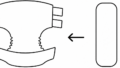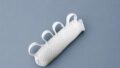
The repositioning support pad “Tokozure Nurse,” which I introduced in a previous article, is still being used by my mother. It is also a product I personally like.
→→Convenient for Repositioning: Bedsore Nurse Pad Review
When I looked into Kuroda Co., Ltd., the company behind this product series, I learned that Fusion, the material used in this pad, is also used in many other care products. The fact that the same material is used across various care products made me wonder whether there may be structural reasons why it appears practical in certain care settings.
In my previous article, I briefly introduced the characteristics of the bed pad and the features of Fusion. But what kind of structure creates those features? In this article, I will explore the three-dimensional knitted material known as “Fusion,” using a patent filed by Asahi Kasei Fibers as a reference.
Please note that this article is based on my personal research and interpretation. It does not guarantee the accuracy of the information. Please make any decision to purchase or use the products mentioned here at your own discretion and responsibility.
Some product links in this article may contain affiliate links (PR).
The English translations of product and feature names used in this article are descriptive translations and have not been confirmed as official English names.
What Is Fusion?
Fusion is a three-dimensional knitted fabric developed by the Asahi Kasei Group.
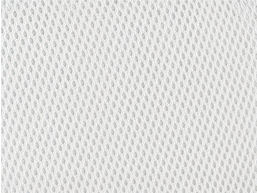
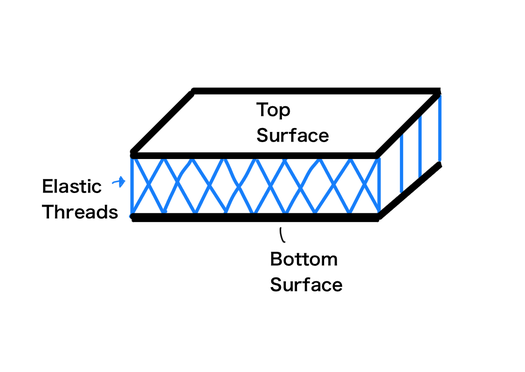
Ordinary fabric is usually a single flat sheet. In contrast, Fusion has a three-dimensional structure in which two knitted layers, one on the front side and one on the back side, are connected by many connecting yarns. One way to visualize this structure is to imagine many small pillars standing between two sheets of fabric.
According to Asahi Kasei’s website, the material has the following features:
○Cushioning: It is described as having excellent compression characteristics.
○Breathability: The front and back knitted layers are mesh-like, and they are not simply layered on top of each other. Instead, they are connected in a three-dimensional structure, which is described as allowing air to pass through more easily.
○Quick drying: The material is described as drying quickly because it retains very little residual moisture.
○Lightweight structure: Although the material has thickness, it contains many air layers, making it lightweight.
Among these features, breathability and lightness are relatively easy to understand from the structure of the material.
Cushioning, however, was a little harder for me to picture. In particular, I wondered why the material tends to return to its original shape after being compressed.
At first, I thought the cushioning came simply from layering fabric.
However, as I looked into it further, it seemed that another structural design may be involved. To explore this further, I read a patent specification related to a three-dimensional knitted fabric by Asahi Kasei Fibers.
How Fusion Works: Insights from the Patent
I could not confirm whether the patent I used as a reference is the patent for “Fusion” itself. However, it was filed by Asahi Kasei Fibers Corporation and appears to share many features with the publicly described characteristics of Fusion. For that reason, I will refer to it here as background information for understanding how this type of material may work.
The patent describes a three-dimensional knitted fabric for use as a cushioning material. It consists of two knitted layers, one on the front side and one on the back side, connected by connecting yarns.
The purpose of the invention is to create a three-dimensional knitted fabric that has an appropriate sense of resilience for use as a cushioning material and that can more easily return to its original shape even after repeated compression in the thickness direction.
At first, I assumed that the material used special elastic yarns.
However, after reading the patent, it seemed that the key point was not only the material itself, but also the structural design. The key element is the connecting yarns that link the front and back knitted layers.
When the three-dimensional knitted fabric is compressed, these connecting yarns bend like springs. When the load is removed, they try to return to their original shape. In other words, the cushioning property of this material does not appear to come from cotton or another filling material packed inside. Rather, it can be understood as being created by many connecting yarns between the two knitted layers that bend and return.
In the patent, the term “hysteresis loss” is used to describe this ability to return. Hysteresis loss refers to the proportion of energy applied during compression that is lost as friction, heat, or other forms of energy, rather than being returned as restoring force.
In this invention, the following design approaches are described for the connecting yarns in order to reduce hysteresis loss, or in other words, to make the material more likely to return to its original shape after being compressed.
Material: The patent describes the use of monofilament yarns as the connecting yarns. A monofilament is a yarn made from a single filament, and the patent suggests that this type of yarn may be suitable because it is more likely to return to its original shape after being bent.
Bending shape: The connecting yarns are arranged in a moderately bent state in advance. This structure is proposed so that the yarns can deform naturally when compressed and return more easily to their original shape after the load is removed.
Arrangement: The connecting yarns are arranged diagonally, in a crossed X-shaped pattern, or in a truss-like V-shaped framework. The patent describes this arrangement as a way to help support the front and back knitted layers more stably, distribute load, and maintain the three-dimensional structure.
Through these structural features, the connecting yarns can bear load while still being more likely to return to their original shape. As a result, the invention appears to aim for a three-dimensional knitted fabric with reduced hysteresis loss and improved resilience after repeated compression.
Advantages of Fusion as a Material for Care Products
In my previous article about a product using Fusion, I introduced the following points based on my actual experience using the product:
○It had moderate resilience and felt comfortable when lying on it.
○The fabric felt firm and did not wrinkle easily.
○I felt that it was breathable, smooth against the skin, and quick to dry.
○It was also easy to handle during caregiving.
At that time, I summarized these points as features I noticed through actual use.
After reading the patent as background information, I feel that I can now understand a little more about how these features may be related to the structure of the material.
What the Patent Suggests
First, this material is a single sheet of fabric, but it has moderate cushioning due to its three-dimensional structure. Of course, it is not a product whose main purpose is pressure redistribution in the same way as a mattress or cushion.
However, when a material used on the body-contact surface of a sheet or pad has moderate resilience, I felt that it may help make localized pressure feel less pronounced or reduce the sensation of the material sticking flat against the skin.
The fact that I previously felt the material was less likely to wrinkle may also be related to the three-dimensional structure, which allows it to return more easily to its original shape after being compressed. In care settings, wrinkles in sheets or towels can sometimes increase contact stress on the skin or create localized pressure. For that reason, I feel that a material that can maintain its shape easily may offer a meaningful practical advantage from a handling perspective.
In addition, the three-dimensional structure contains many air layers. This may be one reason why, as the manufacturer describes, the material is breathable and dries easily.
For people who are bedridden, sweat and moisture can easily accumulate, and heat and moisture buildup may be one factor to consider when thinking about skin condition in daily care. For this reason, from the perspective of daily care, I felt that a material that allows air to pass through and dries easily after washing can be practical to handle.
My Impressions from Actual Use
My mother also uses a bed pad made with Fusion.
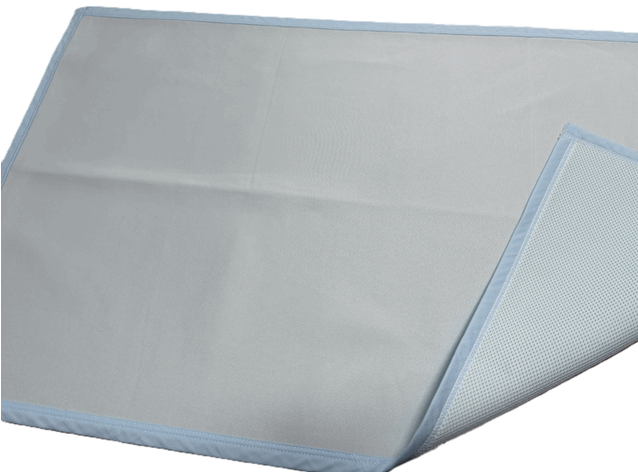
As for sweat on the back, compared with using a bath towel, it seemed to me that the surface was less sticky. It also seemed that moisture and heat were less likely to build up. When the pad is washed, it retains very little water after the spin cycle and dries easily.
It has been used and washed repeatedly, but so far I have not noticed a significant loss of resilience in the material.
Care products are generally used on the assumption that they may become soiled, so washability is important. At home, it may be possible to check the washing instructions carefully. However, in facilities, it can be difficult to check and separate items according to detailed washing labels. Care products are often washed frequently.
For that reason, I feel that quick drying and durability are also important features from a care-handling perspective.
Closing Thoughts
What impressed me most while researching this material was that its cushioning does not come simply from layered thickness, but from its structure. In daily practice, we tend to focus on the product itself. However, learning about the material structure behind the product slightly changed the way I look at care products.
In the next article, I plan to discuss the “Rehabilitation Stick” from the Tokozure Nurse series, which also uses Fusion, and consider its use in care for hands affected by contractures.
Please note that this article is for informational purposes only and does not guarantee the accuracy of the information. Please make any decision to purchase or use the products mentioned here at your own discretion and responsibility.
In this blog, I focus mainly on how welfare equipment, assistive products, and medical supplies are perceived in frontline care settings, and in what situations they are likely to provide value. From the perspective of medical and long-term care settings, I write with the aim of serving as a bridge between companies, business operators, and frontline care settings.
Based on this perspective, I use my frontline experience as a nurse and my knowledge of patents to provide explanations of medical materials and care products, write technical articles, review products, and offer support that may contribute to market development.
For more details, please see: Services
Please feel free to contact me through the Contact form on this blog.
References
Asahi Kasei Fibers Corporation, “Three-Dimensional Knitted Fabric for Cushioning Material”
Japanese Unexamined Patent Application Publication No. 2005-179842
Kuroda Co., Ltd.
http://www.t-nurse.com/pagepad.html
Asahi Kasei Advance
https://www.asahi-kasei.co.jp/advance/jp/business/apparel_and_fiber/cubit.html