
As people age, undernutrition can become a concern not only because of reduced swallowing function, but also because of reduced appetite and eating only small amounts.
In my current work, I also support care recipients who have difficulty eating enough and rely on nutritional supplement drinks to help maintain their nutritional status.
In this article, I will look at ALIMOA, a nutritional supplement drink released by Nutri Co., Ltd. in April 2026.
One reason I became interested in this product was the 2026 revision of Japan’s dispensing fee system.
I will first touch on this reimbursement-related revision, and then look at how ALIMOA differs from conventional nutritional supplement drinks. I will also share my perspective from frontline nursing and care settings.
This article is based on my personal views and research.
It does not guarantee the accuracy of the information. Please make your own decision when purchasing or using any product introduced here.
Some links in this article may include affiliate links or PR links.
Japan’s Dispensing Fee Revision and Nutritional Supplement Drinks
As Japan’s population ages and the birthrate declines, national medical costs continue to rise year by year.
In recent years, discussions about how to control rising medical expenses have included topics such as reviewing the high-cost medical expense benefit system and increasing patient out-of-pocket costs for medicines similar to over-the-counter drugs.
As part of this broader movement, the 2026 revision of Japan’s dispensing fee system also includes efforts to optimize the prescribing of enteral nutrition products.
An enteral nutrition product is a liquid nutritional product used to provide nutrition for people who have difficulty eating enough by mouth or whose digestive and absorptive functions in the stomach or intestines are reduced. It may be administered through a feeding tube or gastrostomy tube, or it may be taken orally.
Because enteral nutrition products may be used as substitutes for meals, they are high in calories and contain a balanced range of necessary nutrients. Some are liquid, while others are semi-solid and have a thick consistency.
The reason these nutritional products are used to support meals is not only that they are nutrient-dense. Another important reason is that, when they are prescribed as medical products, they may be covered by medical insurance. This can make them easier for care recipients to continue using while reducing the financial burden.
In fact, commercially available nutritional supplement drinks are often more expensive than ordinary juice. For this reason, in care settings, staff often first consider products that are available by prescription.
However, because of this reimbursement revision, it may become more difficult to suggest them in the same way as before.
The revision defines the patients eligible for prescribed enteral nutrition products as follows:
- Patients who have undergone surgery
- Patients receiving nutrition through a tube
- Patients for whom a physician determines that the use of a medical product to maintain nutrition is medically necessary, such as when it is required for the treatment of a disease and cannot be replaced by other foods
In other words, insurance coverage is moving in a direction where it may become more difficult to use these products solely for nutritional support in people who simply eat only small amounts.
Among the older care recipients I work with every day, many are not eating less because of a specific disease. Rather, because of aging, the amount they can eat has decreased, and it has become difficult to maintain their nutritional status through meals alone. In the future, it may become more difficult to support such people with prescribed nutritional products.
I can understand the reasoning behind the system.
However, in frontline care settings, this creates a new question:
How should we support nutrition for these people going forward?
This practical concern is one reason I became interested in ALIMOA.
Challenges with Conventional Nutritional Supplement Drinks
Until now, several products such as Ensure and Racol have been used as nutritional supplement drinks that can be prescribed.
Each product has different ingredients and features.
However, they share one common point: they provide a high-calorie, nutrient-dense option in a small volume, making nutritional support more efficient.
On the other hand, many of these products have a thick, sweet, milk-like quality.
I have tasted some of them myself. They were rich and quite sweet, with a heavy aftertaste that gave me the impression of “calories and nutrients packed tightly into one drink.”
In actual care settings, I often hear older adults say things like:
“I can’t drink it because it’s too sweet.”
“It just doesn’t go down.”
Of course, some people find them sweet and tasty and can drink them without any problem. However, in my experience, many people seem to drink them not because they like them, but because they know they need the nutrition.
So why do conventional nutritional supplement drinks tend to have this strong milky quality?
One reason is the way calories are increased.
When trying to raise the calorie content of a drink efficiently, fat is useful. Fat provides 9 kcal per gram, which is more than twice the energy provided by carbohydrates or protein. This means that even a small amount of fat can efficiently increase the calorie content.
When I look at the ingredients of nutritional supplement drinks commonly used in my workplace, I often see several oils combined, such as corn oil, perilla oil, fish oil, and soybean oil.
However, when fat is added to a drink, there is a problem: fat does not dissolve well in water.
For example, in salad dressing, oil floats on top and separates from the water-based portion. Oil and water are naturally difficult to mix. In nutritional supplement drinks, however, oil needs to be mixed evenly with proteins, vitamins, and other ingredients in water so that the product can be consumed as a drink.
This is where emulsification is used.
Emulsification is a technique that finely and stably disperses oil and water, which normally do not mix easily. The emulsifiers used for this purpose have both a water-friendly part and an oil-friendly part. This mechanism is similar to that of surfactants used in detergents.
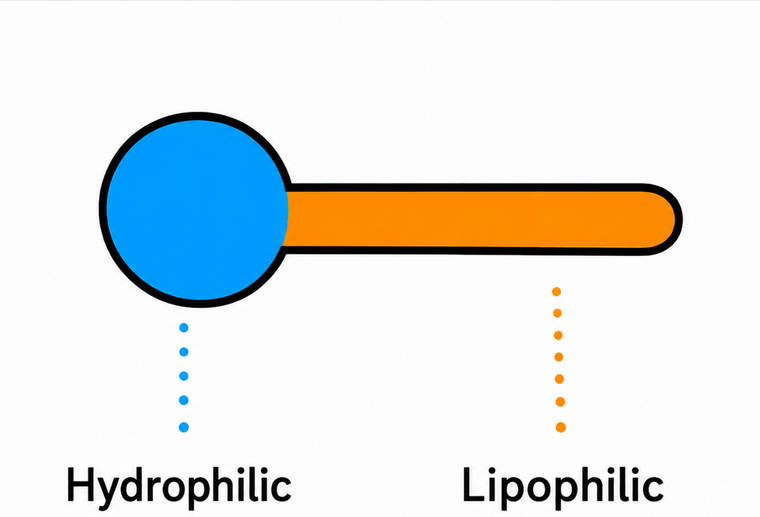
Emulsifiers line up on the surface of oil droplets and connect the oil side and the water side.
As a result, oil droplets are less likely to gather together, making it easier to keep them finely dispersed in water.

Milk is actually one example of an emulsion.
In milk, milk fat is finely dispersed in water. Milk proteins such as casein also play a role in stabilizing this dispersion.
In nutritional drinks, protein is also important, not only for calories but also for supporting muscle maintenance and nutritional care for older adults. For this reason, milk proteins such as casein and whey are also often used.
In this way, high-calorie drinks often use fat and milk proteins and stabilize them as a drink through emulsification. As a result, they tend to become milky, rich, and heavy, similar to milk.
When sweetness from sugars is added to this, it can create a distinctive heaviness and sweetness. For some people, I feel that this may contribute to difficulty drinking them.
ALIMOA
What Is ALIMOA?
The drinking experience often associated with nutritional supplement drinks is not limited to prescribed enteral nutrition products. It is also commonly seen in commercially available high-calorie drinks.
In fact, drugstores and online shops sell many similar milk-based drinks. So if cost is not an issue, it is possible to find alternative products.
However, if a person is going to purchase a product out of pocket, I began to think:
Is there something that may be easier to drink and better suited to that individual?
That is when I found ALIMOA.
ALIMOA is a nutritional supplement drink released by Nutri Co., Ltd. in April 2026.
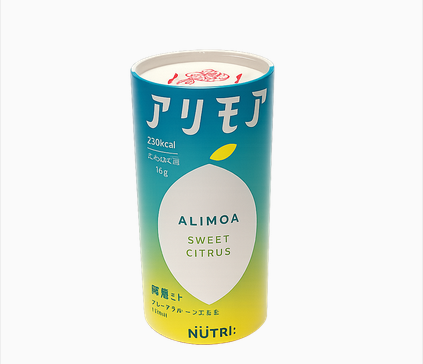
On the product introduction page, the catchphrase describes it as a nutritional supplement drink that is refreshing, tasty, easy to finish, and focused on selected necessary nutrients. This wording suggests that ALIMOA emphasizes not only nutrient density, but also ease of drinking.
However, achieving both nutrient density and ease of drinking does not seem to be simple.
Comments from the developers describe challenges such as:
“The more nutrients we add, the sweeter and harder to drink it becomes, moving farther away from something that tastes good.”
“When we adjust the sweetness, the smell of the raw ingredients becomes noticeable.”
From here, I will look at how ALIMOA approaches practical issues in care settings, such as drinks being too sweet or difficult to finish.
Features of ALIMOA
High Calories with 0 g Fat
The first feature that stood out to me about ALIMOA was that it is a clear-type drink rather than a milky one. Conventional nutritional supplement drinks are often similar to dairy products in appearance and mouthfeel.
In contrast, ALIMOA looks like a clear juice. As mentioned earlier, conventional nutritional supplement drinks often use a considerable amount of fat. Because of this, they tend to have a milky taste, richness, and a heavy aftertaste.
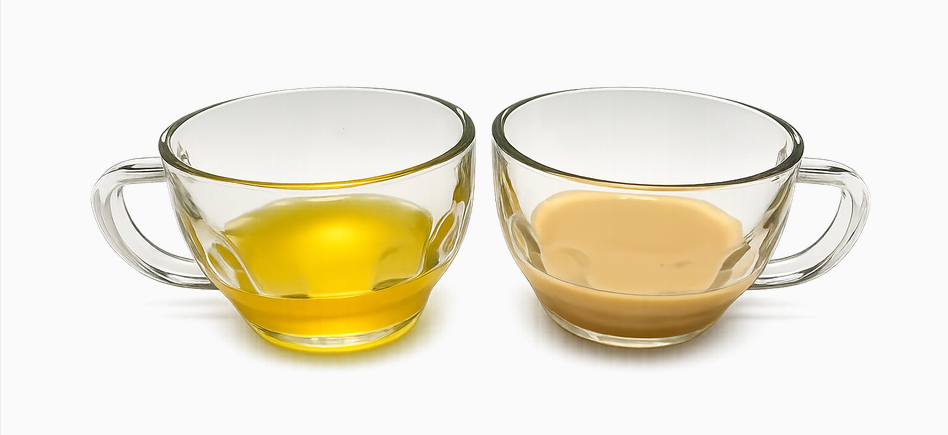
Left: Alimoa (Fat-free) Right: Conventional nutritional drink (With fat)
ALIMOA, on the other hand, provides 220 kcal in a small volume of 125 mL while containing 0 g fat. I feel that this fat-free feature may also be related to its clear appearance.
At this point, I wondered:
If calories are increased without fat, wouldn’t that require a lot of sugar and make the drink extremely sweet?
So how does ALIMOA provide high calories without fat?
Looking at the ingredients, it contains carbohydrates such as starch hydrolysate, glucose, galacto-oligosaccharide, and maltose. In food ingredient lists, ingredients are generally listed in order of amount used. For this reason, it seems likely that starch hydrolysate is one of the main energy sources in ALIMOA.
Starch hydrolysate is a carbohydrate, so it provides about 4 kcal per gram. At the same time, it generally has less intense sweetness than sugar. In other words, it may provide calories without making the sweetness too strong.
In addition, by combining carbohydrates with different sweetness profiles, such as glucose, maltose, and galacto-oligosaccharide, this combination may contribute to adjusting sweetness and aftertaste.
There is no explicit statement confirming this. However, ALIMOA appears to take an approach that provides high calories mainly through carbohydrates rather than fat, while also paying attention to sweetness adjustment and ease of drinking.
Selected Necessary Nutrients
Another point that I felt may contribute to ease of drinking is that ALIMOA does not try to include “everything.”
When trying to increase the nutritional value of a nutritional supplement drink, many ingredients may be added, including fat, protein, vitamins, and trace elements. When we hear the term “nutritional supplement drink,” we may think that a drink containing a wide variety of nutrients would be better.
However, the more ingredients are added, the more likely the drink may develop a distinctive flavor. If you have ever tasted nutritional drinks or nutritional supplements, you may recognize that characteristic “nutritional product” taste.
With ALIMOA, I had the impression that it includes nutrients that are often important for older adults, such as vitamin D and zinc, while avoiding excessive addition of ingredients in order to maintain ease of drinking. The official website also describes it as a drink focused on necessary nutrients.
By not adding too many nutrients, the product may prioritize a practical balance: something that a person can finish and may be more likely to continue. That is one way I interpret ALIMOA’s product concept.
Citrus Flavor
Conventional high-calorie drinks often use flavors that pair well with milk-based products, such as strawberry, banana, and coffee. ALIMOA, by contrast, has a citrus flavor that matches its clear appearance.
Of course, ALIMOA is not the first clear nutritional supplement drink positioned as refreshing and easy to drink. For example, non-milk-based products such as Isocal Clear by Nestlé and Sukkiri Clinimeal by Morinaga Milk Industry have existed for some time.
Among these products, however, I found ALIMOA notable because it provides 220 kcal in just 125 mL.
I also felt that its citrus flavor, which has not been very common among nutritional supplement drinks, is one of its distinctive features. Citrus flavors often give a refreshing and clean impression. For people who dislike milk-like drinks, ALIMOA may feel easier to drink than conventional nutrient-dense drinks.
For people who cannot eat much and are at risk of insufficient nutrition, efficient nutritional intake is important. However, even before that, the first issue is whether they can actually drink it. If they cannot drink it, they cannot take in the nutrition in the first place.
From that perspective, I feel that the choice of a citrus flavor is also part of the design aimed at making the drink easier to finish.
Packaging That Feels Less Like a Medical Nutrition Product
Conventional nutritional supplement drinks often come in cans or with labels that look similar to medical products. Many of them strongly give the impression of being “nutritional formulas” or “medical nutrition products.”
ALIMOA, on the other hand, comes in a paper carton and looks closer to an ordinary juice. I felt that this may be more than just good design. It may also reduce the feeling of being “made to drink a nutritional supplement.”
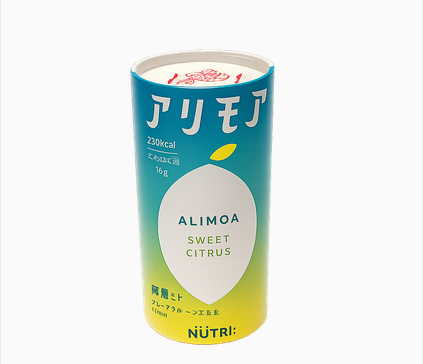
The appearance of a product can influence how we perceive its taste. For this reason, packaging that looks closer to an ordinary drink may be a more meaningful design choice than it first appears.
My Impression After Trying ALIMOA
Ease of Drinking
When I actually tried ALIMOA, my first impression was that it was quite close to an ordinary juice.
The citrus flavor is somewhat strong. When I smelled it, it made my mouth water slightly, as if the aroma stimulated my mouth. This is just my personal impression, but the aroma reminded me of a chewing gum called “Sweetio” that I used to eat.
Perhaps because of the carbohydrate content, it has a slightly syrupy mouthfeel. However, this was different from the sticky heaviness of milk-based drinks. The aftertaste was relatively clean.
I also did not notice much of the distinctive nutrient-derived flavor often found in nutritional drinks or nutritional supplements. Overall, as a high-calorie drink, I found it relatively refreshing and easier to drink, without being overly sweet.
Packaging
The container also has some practical design features.
It can be drunk with a straw or directly from the carton. The container does not seem to be designed mainly for pouring into a cup, but when I actually poured it out, I did not find it particularly easy to spill.
The carton has a rounded shape. Overall, it gives less of a medical-supplement impression and feels closer to an ordinary juice.
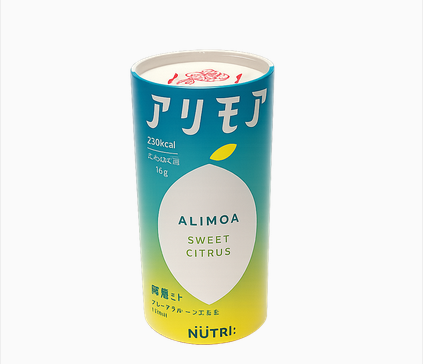
I also personally liked the fresh color and design, which match the citrus flavor. Many conventional nutritional supplement drinks have similar designs that immediately remind people of “nutritional formulas.” Some people may remember the taste just by seeing that kind of package.
I felt that this kind of packaging and container design may reduce the feeling of being “made to drink it” and may make the product feel more approachable.
Adding a Thickener
I also tried adding a thickener, and the drink thickened without any obvious problem.
Many older adults have reduced swallowing function and need thickened liquids. For this reason, I felt this may be a practical point in care settings where thickened liquids are needed.
How Filling It Feels
Previously, I attended a study session where we tasted several nutritional supplement drinks a nd jellies. Even though I only tasted small amounts, my stomach felt heavy afterward, and I did not feel hungry for some time. I think this is because rich nutritional supplements containing a lot of fat and protein can feel filling and heavy in the stomach.
ALIMOA, however, contains 0 g fat. For that reason, it may not feel as filling as conventional fat-containing products.
However, if we consider it not as a meal replacement, but as nutritional support in addition to meals, not feeling too heavy can also be an advantage. It may be less likely to interfere with the next meal.
A Care Recipient’s Response After Trying It
This time, I asked one care recipient to try ALIMOA. This person dislikes milk-based drinks but has been managing to drink nutritional supplement drinks for nutritional support.
After trying ALIMOA, the person said:
“This is good.”
“I can drink this.”
Compared with previous nutritional supplement drinks, the person appeared to drink it more smoothly.
This was not a long-term trial. Therefore, I do not know whether the person would be able to continue drinking it over time without getting tired of the flavor.
Still, at least for someone who dislikes milky taste or overly sweet drinks, I felt that ALIMOA may be easier to incorporate. It may also serve as a different flavor option for people who have become tired of conventional nutritional supplement drinks.
Points to Note
●ALIMOA is a nutritional supplement drink sold as a food product.
It is different from enteral nutrition products prescribed as medicines. For that reason, it is better not to use it as a meal replacement based solely on personal judgment.
●ALIMOA is also mainly carbohydrate-based.
People with diabetes or those who need blood glucose management should consult a physician or other healthcare professional before incorporating it into their diet.
Where to Buy
As of May 2026, ALIMOA appears to be available through the official website as well as online shops such as Rakuten.

Prices vary depending on the retailer, but it is often sold for around 220 yen per bottle. Many retailers sell it by the box, but I also found sites where it can be purchased individually or in small trial sets.
The official Nutri website also provides information about sample requests for hospitals and facilities.
Official website: https://www.nutri.co.jp/nutrition/alimoa/index.html
Closing Thoughts
In nutritional support for older adults, nutritional value and taste are important. However, being able to continue is just as important.
Nutritional status does not change immediately just because someone drinks a nutritional supplement once. That is why small daily experiences such as “I can drink this today” become important in practical nutritional management.
After actually trying ALIMOA, what I appreciated most was that it did not seem to focus only on adding as many nutrients as possible. Rather, I felt that it was made with attention to questions such as:
How can the drink be made easier to consume?
How can it be made easier to continue?
From a frontline nursing perspective, I felt that it is a product that pays attention to real concerns in care settings. The clear fat-free formulation, citrus flavor, and paper carton appearance all seem connected as design choices intended to make the drink easier to consume. In particular, the refreshing citrus flavor may also suit the warmer season ahead.
For those who struggle to get someone to drink nutritional supplement drinks, or for those who are concerned about nutritional support after this reimbursement revision, ALIMOA may be one option to consider.
In this blog, I focus on how welfare equipment, medical materials, and care products are perceived in frontline care settings, and in what situations they are likely to provide value. From the perspective of medical and care settings, I aim to serve as a bridge between companies and frontline care settings.
Based on this perspective, I use my hands-on nursing experience and knowledge of patents to write explanations of medical materials and care products, technical articles, product reviews, and support that may contribute to market development.
For more details, please see: Services
Please feel free to contact me through the inquiry form on this blog.
This article is for informational purposes only and does not guarantee the accuracy of the information. Please make your own decision when purchasing or using the product.
References
Nutri Co., Ltd.
https://www.nutri.co.jp/nutrition/alimoa/index.html
Nestlé Health Science
https://www.nestlehealthscience.jp/brands/isocal-ons-liquid/isocal-clear
Morinaga Milk Industry / Clinico
https://www.clinico.co.jp/products/assistance/drink/sukkiri.html
The Japan Dietetic Association
https://www.dietitian.or.jp/data/medical-fee/r08/document/r8_medical-fee46.pdf
Japan Cosmetic Industry Association
https://www.jcia.org/user/public/knowledge/explain/surfactant
Taiyo Kagaku Co., Ltd.
https://www.taiyokagaku.com/lab/emulsion_learning/01
Tatoryui.com
https://www.tatourui.com/