Interest in oral health has been growing in recent years.
In Japan, the Ministry of Health, Labour and Welfare has focused on the relationship between overall health and oral health. It has been promoting dental checkups and measures against oral frailty. Against this background, there is also growing interest in devices and technologies that support oral care.
In this article, I will discuss OraBubble, a mouthpiece-type oral irrigator that uses fine bubbles.
Based on official information and the patent description, I will explain how OraBubble works. I will also consider how it may be used in nursing and long-term care settings.
This article was written with permission from the product developer.However, it is not a sponsored or paid article. It is my analysis from the perspective of a nurse, based on publicly available information and the patent description.
Why Oral Care Matters in Medical and Long-Term Care Settings
When people hear the term “oral care,” many may first think of reducing the risk of cavities or periodontal disease.
However, in medical and long-term care settings, oral care means more than that. Keeping the inside of the mouth clean may help reduce bad breath and improve comfort. It is also related to eating and communication.
For older adults, the condition of the teeth and mouth is known to be related to the maintenance of daily living functions. The Ministry of Health, Labour and Welfare also explains oral health in relation to functions such as “eating” and “speaking.”
Oral care is also important from the perspective of reducing the risk of aspiration pneumonia in medical and care settings. This is especially important for people with reduced swallowing function and for those who cannot eat by mouth.
In my own experience in elderly care and medical settings, I sometimes check the condition of a care recipient’s mouth to see whether daily care is being provided appropriately.
The condition of the mouth often reflects the quality of daily care. However, depending on the care setting, oral care may not always be given enough attention. The quality of care may also vary depending on who provides it.
Why Oral Care Can Be Difficult in Frontline Care Settings
Many people brush their teeth after meals.
In care facilities, eating and oral care are also usually provided as a set. Oral care is generally provided even for people who cannot eat by mouth.
Oral care is difficult not only because it must be provided several times a day.
In actual care settings, there are many challenges, such as:
- It takes time.
- Care recipients may resist it.
- The quality of care may vary depending on the staff member.
- There is a risk of biting incidents.
- Some people may cough during rinsing.
OraBubble’s facility-oriented website also lists these types of frontline challenges.
Personally, I think one major issue is that oral care is highly dependent on manual technique.
The caregiver’s technique can affect the quality of care. It can also affect how long the care takes and whether the experience is uncomfortable for the person receiving care. In some cases, it may also lead to resistance to care or the risk of being bitten.
Most of us have learned how to brush our teeth at school or at a dental clinic. Even so, we still sometimes receive care from dental hygienists. Children who cannot brush well also need assisted brushing by a parent.
This shows that toothbrushing may look simple, but it actually requires skill. For this reason, in medical and care settings, staff learn and practice how to provide oral care for another person.
However, when oral care is performed carefully, it is not enough to clean only the tooth surfaces. It is also necessary to check and clean the interdental spaces, gums, tongue, and buccal mucosa.
When providing oral care for another person, the difficulty also depends on how widely the person can open their mouth and how much they can cooperate.
If oral care is done quickly, cleaning may be insufficient. On the other hand, if it is done carefully, it takes time. This is one of the difficulties in frontline care settings, where care must be provided with limited time and staffing.
This issue of being “highly dependent on manual technique” is not limited to brushing.
Conventional oral care requires different techniques for different areas of the mouth. It is also divided into separate steps, such as brushing, cleaning interdental spaces and the tongue, and rinsing. Each of these actions must be performed by hand while adjusting to the condition of the person receiving care. For this reason, oral care can easily become dependent on the caregiver’s technique.
This concern also appears in the background section of the patent.
The patent document points out the following issues:
- Conventional toothbrushes and electric toothbrushes separate the brushing step from the rinsing step.
- Cleaning interdental spaces often requires additional tools.
- Existing technologies using microbubbles or nanobubbles are still mainly based on toothbrush-type or nozzle-type designs, and remain focused on brushing teeth one by one or cleaning interdental spaces one by one.
In other words, the background of OraBubble’s development appears to include the question of whether oral care could be made simpler, more integrated, and easier to handle.
Overview of OraBubble
What Is OraBubble?
OraBubble is a mouthpiece-type oral irrigator.
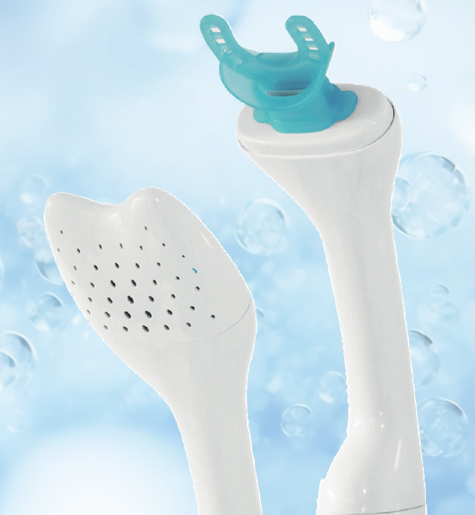
Image source: https://www.orabubble.jp/
It was conceived by Dr. Satoru Ogawara, an internal medicine physician, based on his experience caring for his father at home. The device was reportedly developed with support from various public programs.
The user holds a dedicated mouthpiece in the mouth. Through this mouthpiece, a fine water flow containing fine bubbles spreads throughout the oral cavity and is intended to support oral cleaning.
According to the official product description, OraBubble has the following features:
- It can be used by holding the mouthpiece in the mouth for about one minute.
- Water intake and drainage are separated.
- It does not require electricity or major construction work, and can be installed by branching from an existing washbasin or shower.
Reading the patent, a key aspect of the invention appears to be its design for delivering liquid containing fine bubbles throughout the oral cavity with safety and efficiency in mind.
Key Features of OraBubble
From here, I will look at how the product design creates specific features and how those features may lead to practical advantages.
A Shape That Covers the Dental Arch
In the patent, the device is described as having a dental-arch-shaped portion that is held between the upper and lower teeth. The user bites and holds this portion in the mouth during use.
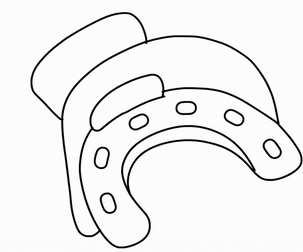
This portion is described as having a substantially flat plate-like shape along the dental arch. Liquid containing fine bubbles flows into this portion, contacts the upper and lower teeth, and is designed to spread throughout the oral cavity.
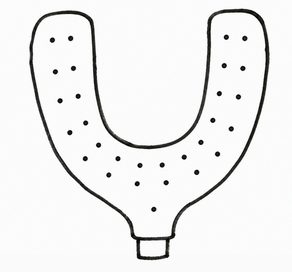
Conventional toothbrush-type or nozzle-type cleaning devices are based on the idea of aiming at a specific area. In contrast, this product has a structure that spans the entire dental arch. This design is intended to deliver the liquid to a wide area at once. I feel that the device’s shape itself creates one of its key features.
Integrating “Brushing” and “Rinsing”
One purpose described in the patent is the integration of the brushing step and the rinsing step.
The aim is to allow the user to clean the oral cavity and tooth surfaces simply by holding the device in the mouth.
From a frontline care perspective, this has significant meaning.
Oral care includes preparation, brushing, rinsing, and handling expelled rinse water. The fact that this sequence may be handled with a single device could help reduce the burden on both the caregiver and the person receiving care.
Separating Water Supply and Drainage
The patent also describes a structure in which the water inlet and drainage outlet are clearly separated.
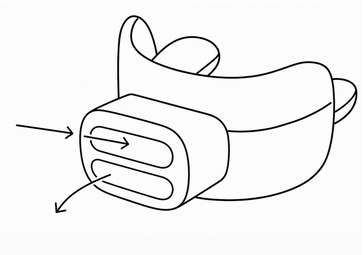
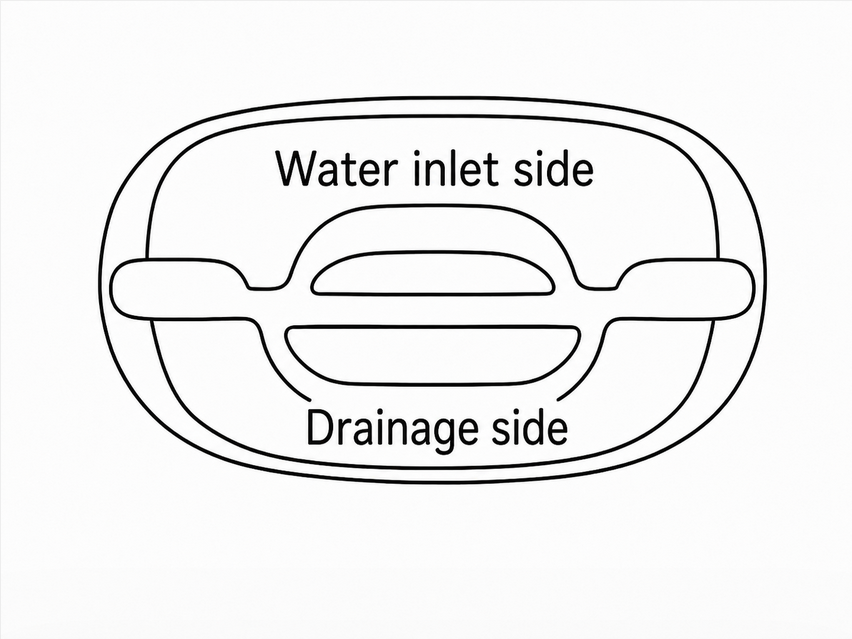
The incoming liquid spreads along the dental arch and flows throughout the mouth. At the same time, it is drained from a separate area.
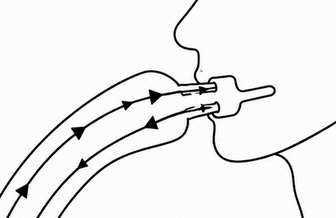
The patent also describes a structure in which the drainage pressure is higher than the water supply pressure. This is intended to make water less likely to accumulate in the mouth and may help reduce the risk of coughing or aspiration.
This is an important aspect related to safety.
When people hear that water flows into the mouth, they may worry about whether water will accumulate, cause discomfort, or lead to aspiration. I think this flow path design is intended to address those concerns.
A Protector That Helps Reduce the Likelihood of Water Flowing Toward the Throat
The patent also describes a water-blocking plate, or protector, on the throat side.
This is designed to make it less likely that the water flow will be sprayed directly toward the throat, even if the teeth are not fully closed.
The structure allows water to be directed to both sides, while spreading from the front upper surface of the teeth toward both ends and then downward. This also appears to be a design made with safety in mind.
Cleaning Using Fine Bubbles
What Are Fine Bubbles?
Fine bubbles are extremely small bubbles with a diameter of 100 micrometers or less.
In the patent, fine bubbles are described as including microbubbles and ultrafine bubbles.
Recently, products such as showerheads using fine bubbles have become more common, so many readers may have heard the term before.
OraBubble uses bubbles that are far smaller than the visible bubbles we usually imagine. These bubbles are so small that they are not visible to the naked eye, and the device uses them for oral care.
Actions Expected from Fine Bubbles
According to the patent, carbon dioxide fine bubbles are described as having the following possible actions:
- Possible cleaning-related action
- Possible bacterial growth-suppressing action
- Possible effect related to blood flow improvement through peripheral vasodilation
The patent also states that carbon dioxide gas displaces oxygen in the water, which may make bacteria less likely to proliferate and may help maintain the cleanliness of the water used for cleaning.
Just as we need oxygen to live, some bacteria grow more easily when oxygen is present. For this reason, when the amount of oxygen in water decreases, some bacteria may be less likely to proliferate.
Mechanisms Related to Cleaning
OraBubble’s cleaning is not only based on the physical action of water pressure from the mouthpiece. The properties of fine bubbles themselves may also be involved in cleaning.
It is explained that fine bubbles may enter narrow spaces such as interdental spaces and periodontal pockets, which may contribute to cleaning areas that are difficult to reach by conventional methods.
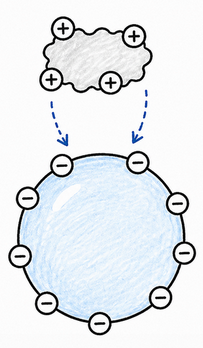
The patent also explains that fine bubbles are described as negatively charged, which may make them more likely to adsorb positively charged contaminants.
The Fine Bubble Industries Association, or FBIA, also lists two factors involved in cleaning by fine bubbles:
- Electrostatic interaction caused by the charge on the bubble surface
- Hydrophobic interaction, in which oily substances gather at the bubble surface
From here, I will look at these mechanisms in a little more chemical detail.
Electrostatic Interaction
What does it mean when the patent says that fine bubbles are negatively charged?
Fine bubbles are bubbles. In OraBubble, the gas used is carbon dioxide, or CO₂. When we hear this, it may sound as if the CO₂ molecule itself has a negative electrical charge. However, that is not the case.
In a CO₂ molecule, there is a difference in electronegativity between carbon and oxygen. Electronegativity refers to the strength with which an atom attracts the electrons in a chemical bond. Because of this difference, the electrons in a CO₂ molecule are distributed unevenly.
However, CO₂ has a linear structure: O=C=O. Because of this shape, the uneven distributions cancel each other out across the molecule as a whole. As a result, CO₂ is a nonpolar molecule.
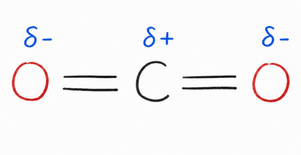
In other words, the CO₂ molecule itself does not carry a negative charge.
So why are fine bubbles described as negatively charged?
The important point is the boundary between the bubble and the water.
In water, water molecules are connected to each other through hydrogen bonding. However, at the surface of a bubble, one side is gas. This means that water molecules cannot align in the same way as they do in the interior of water.
As a result, near the interface, the orientation of water molecules and the distribution of ions such as H⁺ and OH⁻ become uneven. When a layered structure with electrical imbalance forms near an interface in this way, it is called an electrical double layer.
An electrical double layer is a structure in which ions with opposite charge gather near the surface of a colloidal object such as a bubble, while a more gradual imbalance of ion distribution extends outside that layer.
When a bubble moves through liquid, it may look as if only the bubble is moving. In reality, however, some of the liquid very close to the interface and part of the layer of attracted ions move together with the bubble. It is like the bubble moving while wearing a thin surrounding layer.
Within this electrical double layer, the boundary between the fixed layer that moves together with the bubble and the outer layer that moves more freely is called the slipping plane. The electrical potential at this position is called the zeta potential.
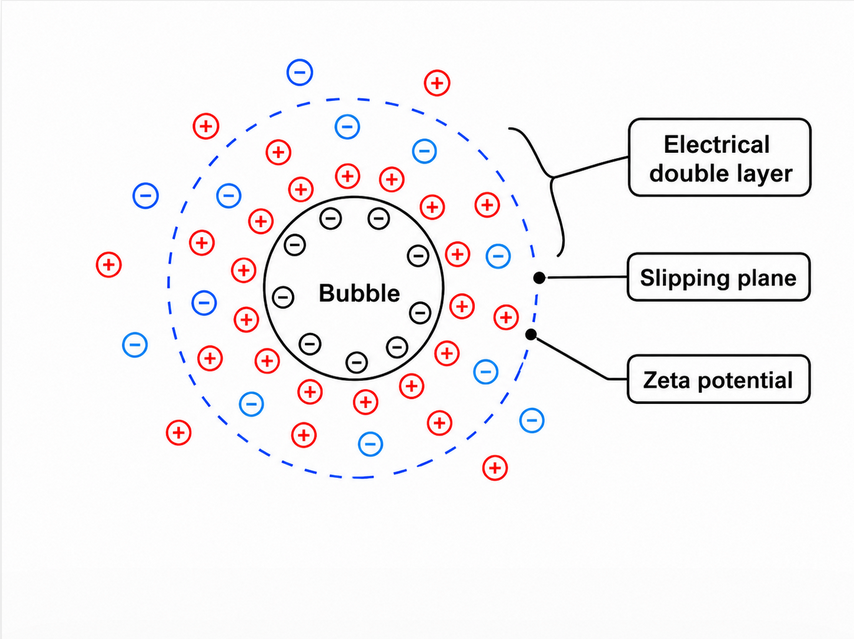
Zeta potential is not the charge of the bubble surface itself. Rather, it is an indicator of how much electrical influence the bubble appears to have from the outside, including the ion layer formed at the bubble interface.
In other words, saying that fine bubbles are “negatively charged” does not mean that the bubble itself has a negative charge. More precisely, it means that the electrical double layer formed at the gas-liquid interface shows a negative zeta potential.
Why this tends to be negative does not appear to be fully understood yet.
In general, it is explained that OH⁻ tends to gather at the gas-liquid interface, which is one reason why bubble surfaces tend to show a negative zeta potential.
This charge also varies depending on pH.
In ordinary water, meaning water with a pH of about 5 to 6 or higher, the charge tends to be negative. On the other hand, as the water becomes more acidic, that negative charge becomes weaker. This is because H⁺ increases under acidic conditions and can neutralize the negative charge around the bubble.
For this reason, in a device like OraBubble that uses water, fine bubbles are considered likely to show a negative zeta potential in water.
As a result, they may attract components of oral contaminants, such as proteins that tend to be positively charged, and may make those contaminants easier to remove.
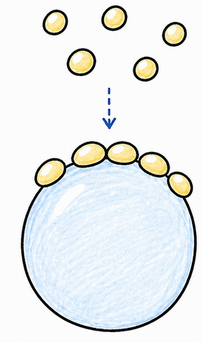
Hydrophobic Interaction
Another chemical basis related to cleaning is hydrophobic interaction.
One characteristic of fine bubbles is that oily substances in water are said to gather easily at the bubble surface.
Hydrophobic interaction refers to the tendency of components that do not mix well with water to gather together in water.
Water is a polar substance. Therefore, it does not mix well with nonpolar hydrophobic components such as oil. In water, oil tends to gather with other oil rather than disperse separately, because doing so reduces contact with water.
For example, in salad dressing, the oil portion does not dissolve in water and instead gathers and floats on the surface. If shaken well, it temporarily disperses into small droplets, but it has not truly mixed with water. After a while, the oil gathers together again.
In a similar way, the gas-liquid interface at the surface of a fine bubble has somewhat different properties from the interior of water, where water molecules are connected through hydrogen bonding. Hydrophobic components such as oil are more stable when they gather in places where they can reduce contact with water. For this reason, they are also considered likely to gather at the bubble surface.
Some oral contaminants contain hydrophobic components, such as lipids from food. These components may be attracted to fine bubbles, which may make them easier to remove.
A Supplement on Cleaning Capability
Dr. Ogawara, the developer, also shared with me the possibility that the cleaning capability of fine bubbles may involve not only zeta potential, but also a state that resembles certain aspects of a supercritical fluid.
In extremely small bubbles, internal pressure becomes high. According to his view, such a special state may also be related to cleaning capability.
Possible Uses in Care Settings
How might OraBubble be used in actual long-term care settings?
I have not used the device myself yet. However, based on the product’s features and the challenges of oral care in care settings, I considered several possible situations.
Situations Where Technique Differences Easily Appear
Oral care is highly dependent on manual technique.
The difficulty changes greatly depending on factors such as remaining teeth, tooth alignment, tongue coating, and how easily the person can open their mouth.
In this respect, I feel that OraBubble may offer an important practical advantage. The user holds the device in the mouth, and the device is designed to provide a more standardized cleaning process. This means that each instance of care may not need to depend too heavily on the caregiver’s manual technique.
Differences in manual technique may lead to several issues, including difficulty maintaining cleanliness, variation in the time required for care, and increased burden on both the care recipient and the caregiver. OraBubble may be one possible option for reducing these issues to some extent.
Care for People Who Have Difficulty Opening Their Mouth or Who Resist Care
In oral care assistance, it is common for a person not to open their mouth or to close it midway through care.
I have personally been bitten by a person who had difficulty following instructions to open the mouth. Of course, teeth can cause injury. But even without teeth, being strongly pinched by the gums can be quite painful and may still lead to injury.
When a person does not open their mouth, caregivers sometimes have to insert a brush through a small gap and clean the mouth without being able to see well inside. In my own experience, this can lead to inserting the brush too deeply or injuring the gums and causing bleeding.
From this perspective, not having to insert fingers or a brush into the mouth—or being able to reduce such situations—could be a major advantage not only for caregivers but also for care recipients.
Many people resist oral care.
Cognitive function can be one reason. However, I think there are often other feelings involved, such as “It hurts,” “It feels rough and unpleasant,” or “I do not want someone looking inside my mouth.” We would probably also feel uncomfortable if someone stared into our mouth or touched it roughly.
In that sense, reducing the situations where a person’s mouth must be brushed manually may help reduce resistance to care in some situations.
It may also reduce the emotional burden on caregivers. Resistance to care itself is not unusual. However, when it continues repeatedly, it can become emotionally difficult.
This is an extreme example, but I have actually seen someone leave a job after struggling with strong resistance from a particular care recipient.
Aspiration Risk
In medical and care settings, meals are handled with great care to prevent aspiration and choking. Staff assess whether the food texture and assistance method match the person’s swallowing function, often while referring to evaluations by rehabilitation professionals.
But what about toothbrushing?
This is based on my personal experience, but I feel that methods for toothbrushing and oral care are not as widely shared as methods for meal assistance. I also feel that the question of whether the method truly matches the person’s condition is not given as much attention as it is during meals.
In reality, when oral function declines, swallowing may become difficult. Similarly, a person may not be able to rinse the mouth well and may cough because of the rinse water. This is not only a matter of the care recipient’s function. The caregiver’s technique, including how much water is placed in the mouth and at what timing, can also make a difference.
In this respect, OraBubble is designed so that water is less likely to accumulate in the mouth by separating water supply and drainage.
The patent also describes a protector that helps reduce the likelihood of direct spraying toward the throat. This design is intended to make the water flow less likely to go directly toward the throat.
Looking at these points, I feel that OraBubble is not simply a device for washing the mouth. It appears to be designed with attention to coughing and aspiration that can occur during toothbrushing and oral care.
Infection Risk
Although this was not clearly stated as a product feature, I personally wonder whether the device may have the potential to reduce droplet exposure, which could be relevant to infection control in care settings.
In actual oral care, saliva from care recipients can be scattered through brushing, rinsing, and coughing. However, because we need to observe the oral cavity carefully, I usually wear a face shield when providing oral care.
Since I have not used the device myself, I cannot make a definitive statement. However, based on the usage video on the official website, OraBubble appears to be used while the user holds the device in the mouth and keeps the mouth closed. For this reason, I felt that it may have the potential to reduce droplet exposure for the caregiver, at least from the perspective of how the device is used.
Use at Home
The device is described as not requiring major construction work. Therefore, it may be easier to consider not only for facilities but also for home care.
When assistance is needed, it is difficult for family members to provide oral care after every meal.
Also, based on my personal experience, when the caregiver is a family member, the care recipient may resist more because of the family relationship. As a result, oral care may not be performed sufficiently because the person resists it or because the caregiver cannot brush well. In some cases, oral care may become a lower priority, with the reasoning that “we cannot do it, so we do not do it.”
In such situations, a device like OraBubble, which may be easier for both the person receiving care and the caregiver to use, may help make oral care at home easier to incorporate into daily routines.
Points to Note
The official website advises that brushing should be performed when there is visible contamination.
Oral care is also an opportunity to observe the inside of the mouth.
For this reason, oral care should not be replaced entirely with a device. In facilities, staff still need to observe the oral cavity and check whether there are any abnormalities and whether cleaning has been performed sufficiently.
It is also necessary to confirm whether the device is appropriate for the individual user.
According to official information, the target users are people who can maintain a sitting position with light assistance, or people who can maintain a sitting position for up to one minute with support.
Therefore, before adopting the device, it is necessary to confirm whether it matches the condition of each care recipient.
Additional Reimbursement
The facility-oriented page states that introducing OraBubble may help support eligibility for the Oral Function Improvement Add-on. It also presents the acquisition of a TAIS code as one of the product’s values.
An add-on refers to additional reimbursement that can be claimed on top of the base reimbursement when a service meeting certain requirements is provided.
Additional reimbursement under Japan’s long-term care reimbursement system is designed for initiatives that the long-term care sector is expected to strengthen. In other words, if a provider establishes the necessary system and implements the service, additional reimbursement may be claimed. This is designed to encourage providers to strengthen care when reimbursement makes it more feasible.
However, the Oral Function Improvement Add-on cannot be claimed simply by introducing a device such as OraBubble.
According to information from the Ministry of Health, Labour and Welfare, the add-on cannot be claimed if the service does not include “guidance or implementation of training related to eating and swallowing functions” as part of oral function improvement services.
In other words, assessment, goal setting, implementation, and documentation are required as part of practical operation.
In reality, it can be difficult to understand from the written requirements alone what exactly needs to be done. There are also many detailed requirements, and building an operational system for claiming reimbursement can become a burden.
Furthermore, although the system should originally exist to improve the quality of care, the act of obtaining the add-on itself can sometimes become the goal. As a result, “actions for the sake of claiming the add-on” may take priority over actual care.
In this respect, OraBubble appears to provide documentation support and operational support with reimbursement requirements in mind.
For care providers, support that goes beyond simply selling the product and extends to the preparation of operations for reimbursement may become a meaningful benefit.
Closing Thoughts
When I first learned about OraBubble, I simply thought that using fine bubbles for toothbrushing sounded promising. I also felt a sense of clinical relevance and reassurance knowing that the product had been developed by a physician.
However, after reading the patent and learning more about the product, I felt that the appeal of OraBubble goes beyond that.
The essence of this product lies in its structure: how to deliver liquid containing fine bubbles, which are expected to have cleaning properties, safely and efficiently throughout the oral cavity.
Through this design, the device attempts to make the oral care process as simple and integrated as possible. I think this could be a meaningful practical advantage in frontline care settings.
From the perspective of medical and long-term care settings, this device may help reduce differences in manual technique during daily oral care. It may also help reduce the burden on both care recipients and caregivers. In addition, I feel that it may serve as one possible option for oral care that takes coughing and aspiration into consideration.
At the same time, no matter how good a product may seem, it cannot be adopted simply because frontline staff think it is good.
In reality, facilities must consider whether the device is worth the cost, whether it can be implemented in daily operations, and who will manage it. In that sense, the possibility that the device may help support eligibility for additional reimbursement when the required operational conditions are met, together with support for post-adoption operation, may make the product easier to consider not only from a frontline care perspective but also from a facility management perspective.
Compared with meal-related care, oral care may receive less attention. However, oral care should also be considered as a form of care that needs to be adapted to each person’s condition. OraBubble made me think about this again.
Because this is a new type of product that I have not used before, I would first like to try it myself. I would also like to see how care recipients respond when using it.
The official website includes various types of information for facilities. If a facility is considering adoption or a trial, it may be a good idea to start by consulting the company.
In this blog, I focus not only on welfare equipment and medical care products themselves, but also on how such products are perceived in frontline care settings and in what situations they are likely to provide value.
From the perspective of medical and long-term care settings, I aim to serve as a bridge between companies and frontline care settings.
Based on this perspective, I use my clinical experience as a nurse and my understanding of patents to provide explanations of medical supplies and care products, technical article writing, product reviews, and support that may contribute to market development.
For more details, please see the Service List.
Please feel free to contact me through the inquiry form on this blog.
This article is for informational purposes only. I do not guarantee the accuracy of the information provided. Please decide whether to purchase or use the product at your own discretion and responsibility.
The images used in this article are published with permission from the product developer.
References
OraBubble Inc.
https://www.orabubble.jp/
J Alliance Co., Ltd.
https://orabubble-care.jp/
Fine Bubble Industries Association
https://fbia.or.jp/fine-bubble/fine-bubble-knowledge/action-and-utilization/?utm_source=chatgpt.com
Ministry of Health, Labour and Welfare, Latest Information on Long-Term Care Insurance
https://www.mhlw.go.jp/content/001227728.pdf
McMurry, Organic Chemistry, 8th edition, Tokyo Kagaku Dojin, 2012.
Yoshinobu Urabe, Kagaku no Shin Kenkyu, Sanseido, 2019.
“Cleaning Instrument” (WO2017/115836), Satoru Ogawara.