For some older adults and people whose swallowing function has declined because of illness, enjoying a favorite drink as they once did can become difficult.
Recently, the family of a care recipient who loves coffee told me they had been buying Komeda Coffee’s Thickened Coffee (TOROMI Coffee).
I liked the idea of having another way to enjoy Komeda’s coffee when thickened drinks are needed. It also made me curious: what goes into making this product?
In previous articles, I have explored reduced swallowing function and introduced products such as spoons and foods designed to support swallowing, as well as thickening agents.
In this article, I explore how thickening works and what the ingredients may tell us about Komeda’s Thickened Coffee. I approach the subject from nursing and chemistry perspectives, drawing on related patents held by Morinaga Milk Industry, which collaborated in the product’s development.
Disclaimer:This article is based on my personal research and interpretation. I do not guarantee the accuracy or completeness of the information provided. Please review the relevant information and make your own informed decisions regarding product purchase and use.
Some product links in this article may be affiliate links. (PR)
Note:“Komeda’s Thickened Coffee” is used as a descriptive English rendering of the Japanese product name. It has not been independently confirmed as the official English product name.
- Why Thickening Drinks Matters When Swallowing Function Declines
- How Swallowing Works
- Foods and Drinks That Can Be Difficult to Swallow
- Why Are Drinks Thickened?
- Komeda Coffee’s Thickened Coffee
- Exploring What Goes Into Komeda’s Thickened Coffee
- Preparing and Tasting the Coffee: My Impressions
- Where to Find Komeda’s Thickened Coffee
- Closing Thoughts
- References
Why Thickening Drinks Matters When Swallowing Function Declines
When swallowing function declines due to aging or illness, the risk of aspiration or choking may increase.
Food and drink consistency may therefore need to be adjusted according to the individual’s swallowing function. This may involve modifying food hardness, cohesiveness, or the thickness of liquids.
I have explained the swallowing process in more detail in previous articles. Here, I will briefly review the basics to explain why drinks may be thickened for people with reduced swallowing function.
How Swallowing Works
From recognizing food to moving it into the stomach, swallowing can be described in five main stages.
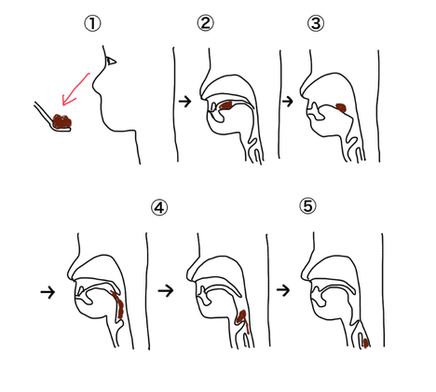
1. Anticipatory Stage (Cognitive Stage)
This is the first stage of eating: recognizing food through our senses and deciding how to eat it.
People with dementia or other conditions may have difficulty at this stage. They may not recognize something as food, may be unsure how to eat it, or may put more food into their mouth before managing what is already there.
2. Oral Preparatory Stage
Food is placed in the mouth, chewed, and mixed with saliva to prepare it for swallowing.
The cohesive mass formed during this process is called a bolus.
3. Oral Transit Stage
The tongue moves the bolus toward the back of the oral cavity and into the pharynx.
4. Pharyngeal Stage
The bolus moves through the pharynx toward the entrance of the esophagus.
During this stage, the swallowing reflex is triggered, and several coordinated movements help protect the airway.
5. Esophageal Stage
The bolus enters the esophagus and is transported to the stomach through peristaltic movements.
If any stage is impaired, food or liquid may remain in the oral cavity or pharynx, or enter the airway instead of passing toward the esophagus.
Foods and Drinks That Can Be Difficult to Swallow
●Foods containing both liquids and solids
Foods such as chunky soups contain thin liquids and solid pieces.
Because the liquid and solid components may move from the mouth to the pharynx at different speeds, they can be difficult to control during swallowing.
●Liquids that are too thin or too thick
Thin liquids, such as water, can flow rapidly into the pharynx.
If the timing of liquid movement does not match the swallowing reflex, aspiration may occur.
On the other hand, liquids that are excessively thick may require greater tongue pressure to move toward the pharynx and may be more likely to leave residue after swallowing.
●Foods that easily break apart in the mouth
Dry, crumbly foods can be difficult to form into a cohesive bolus.
As a result, some particles may enter the pharynx before the rest of the food or remain in the oral cavity or pharynx.
●Hard foods that do not deform easily
Large, hard pieces of food need to be chewed into an appropriate size before swallowing.
They may also be difficult to deform as they pass through the pharynx, which can place additional demands on people with reduced swallowing function.
●Foods that easily adhere to mucous membranes
Some foods, such as mochi (Japanese rice cakes) and roasted nori seaweed, can adhere to the mucous membranes of the oral cavity and pharynx.
This may make them more difficult to move smoothly and increase the likelihood of residue remaining after swallowing.
Why Are Drinks Thickened?
For some people with reduced swallowing function, thin liquids are particularly difficult to control and may increase aspiration risk.
Everyday drinks such as water, tea, and coffee fall into this category.
Once thin liquids enter the mouth, they can flow toward the pharynx within a short period of time.
During swallowing, the larynx moves upward, and the airway closes through coordinated movements involving the vocal folds and other structures. The epiglottis also folds downward, helping protect the airway as food or liquid passes toward the esophagus.
At the same time, the soft palate rises to close off the passage to the nasal cavity, helping prevent food or liquid from flowing back into the nose.
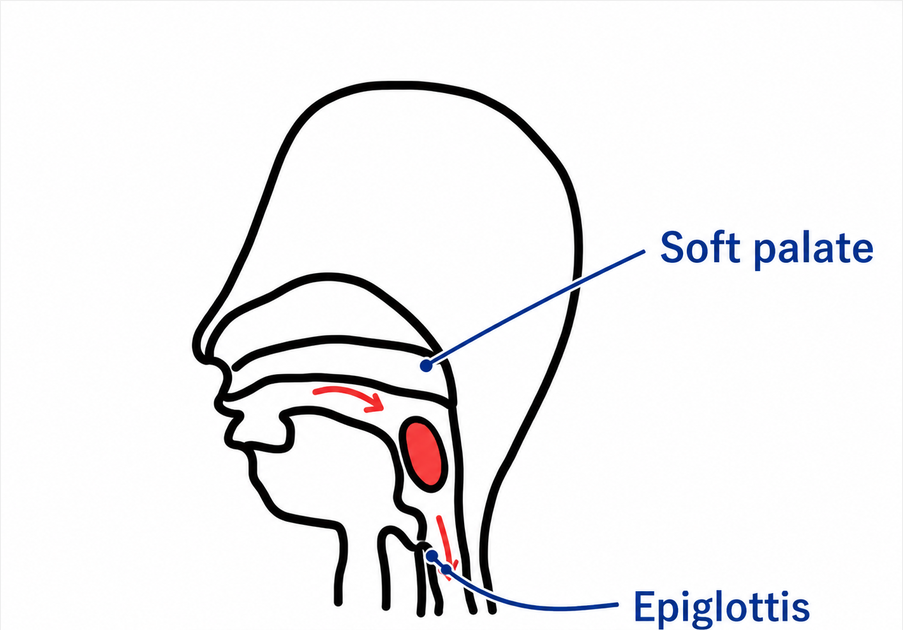
In other words, during the brief moment of swallowing, several coordinated movements take place. Food and liquid are directed toward the esophagus while the airway is protected.
In people with normal swallowing function, these movements are coordinated with the timing of liquid entering the pharynx.
However, aging or illness may delay the swallowing reflex or reduce the ability to hold liquid in the mouth.
When this happens, liquid may enter the pharynx before the airway protection mechanisms are fully activated.
Many of us have coughed after drinking water too quickly or while talking, even without swallowing difficulties.
Similar timing difficulties may occur more frequently in people with reduced swallowing function.
Thickening agents are one approach used to modify liquid consistency for people with swallowing difficulties.
Increasing the viscosity of a liquid generally slows its flow toward the pharynx, which can make it easier to coordinate liquid movement with the swallowing process.
But thicker is not always better.
The appropriate level of thickness depends on the individual’s swallowing function.
If a liquid is too thick, greater tongue pressure may be needed to move it toward the pharynx. It may also be more likely to leave pharyngeal residue.
The goal is not simply to slow the liquid down. Its consistency should also make it manageable to move with the tongue while limiting the potential for pharyngeal residue.
This is an important point when examining the formulation of Komeda’s Thickened Coffee and related patents held by Morinaga Milk Industry. It does not establish that the product is suitable for a particular individual.
Komeda Coffee’s Thickened Coffee
Komeda Coffee’s Thickened Coffee is presented as an option for people who need thickened drinks but would still like to enjoy coffee.
Komeda Coffee is a Japanese coffee shop chain that originated in Nagoya and now operates stores throughout Japan.
Its Thickened Coffee was launched in 2024. It is served at selected locations, and individually packaged servings are also available for preparation at home.
For people who need thickened drinks, ordering and drinking regular coffee at a restaurant or café may no longer be practical.
From my perspective, a thickened coffee option at a café may mean a great deal to someone who has long enjoyed visiting with family or friends—provided the drink is appropriate for their swallowing needs.
The individually packaged version also allows thickened coffee to be prepared at home, offering another way to enjoy the familiar Komeda coffee experience.
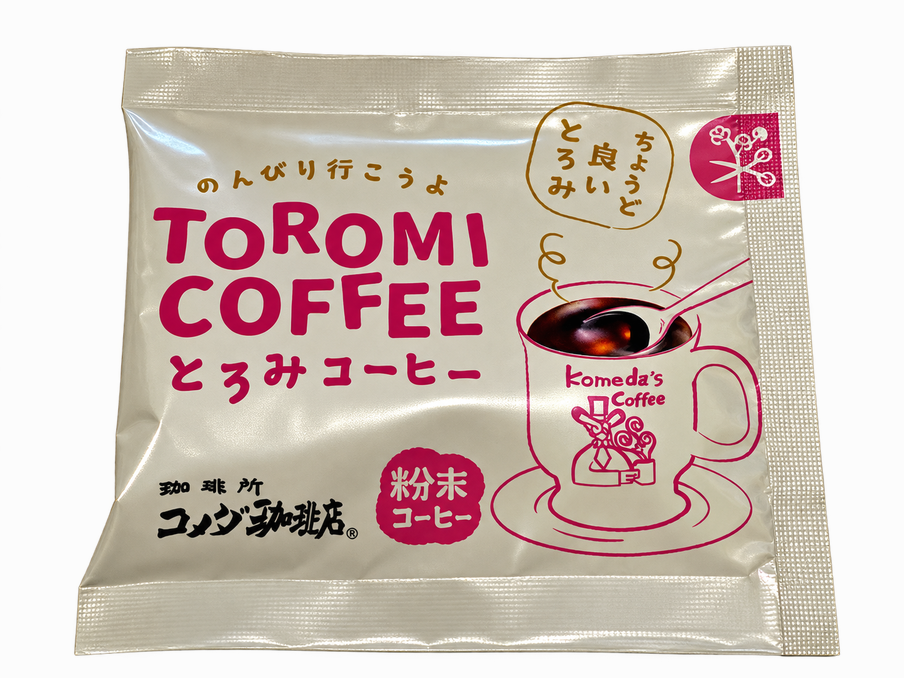
One convenient feature of this product is that the instant coffee and thickening ingredients are already combined in a single serving.
The drink can be prepared by adding hot water and stirring.
Preparing thickened coffee with a separate thickening agent generally involves several steps:
Measure the thickening agent → Add it to the coffee and mix → Wait for the consistency to stabilize → Adjust the thickness if necessary
For family caregivers who prepare these drinks regularly at home, this process may require additional time and effort.
Komeda’s Thickened Coffee combines a single serving of coffee with a premeasured amount of thickening ingredients.
I think this may simplify preparation by removing the need to measure coffee and thickening agent separately. The resulting consistency still needs to be considered in relation to the individual’s swallowing needs.
Exploring What Goes Into Komeda’s Thickened Coffee
The ingredients listed for Komeda’s Thickened Coffee include dextrin, instant coffee, xanthan gum, sodium citrate, and calcium lactate.
To understand these ingredients, I will look at their chemistry alongside related patents held by Morinaga Milk Industry, which collaborated in developing the product.
These patents provide useful technical context, although they do not, by themselves, establish which patented technologies are used in the commercial product.
How Xanthan Gum Creates Thickness
Xanthan gum is a polysaccharide, a polymer made up of long chains of sugar units.
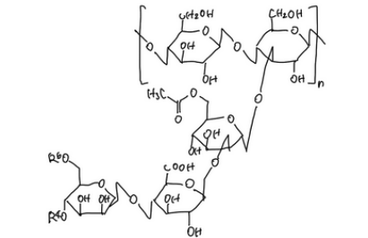
Xanthan gum forms hydrogen bonds with water molecules. Some of its carboxyl groups also dissociate to form negatively charged carboxylate groups (−COO⁻).
Water molecules are attracted to these charged groups, contributing to the hydration of the polymer.
In addition, the negatively charged carboxylate groups repel one another, which can encourage the long polymer chains to adopt more extended conformations in water.
As these long polymer chains hydrate and interact with one another, they increase the liquid’s resistance to flow.
This is the basic mechanism by which xanthan gum increases viscosity.
Same Viscosity, Different Swallowing Characteristics
As discussed earlier, ease of swallowing depends not only on how thick a liquid is, but also on its other physical properties.
One relevant reference is Japanese Patent No. 7429801, held by Morinaga Milk Industry.
The patent looks beyond viscosity alone, examining how thickened liquids of similar viscosity may behave differently during swallowing.
In experiments described in the patent, several test formulations of thickened liquids adjusted to approximately the same viscosity were compared. These findings relate to the formulations and conditions described in the patent, not to a clinical assessment of Komeda’s commercial product.
The patent reports differences in pharyngeal residue, tongue pressure during swallowing, and pharyngeal transit time between the tested formulations.
This suggests that similar viscosity does not necessarily mean that liquids will behave in the same way in the mouth and pharynx during swallowing.
Think of familiar foods such as ketchup, honey, jelly, and yogurt.
Even when they seem similarly thick, they can flow differently and feel quite different in the mouth.
Viscoelasticity in Thickened Liquids
This brings us to viscoelasticity.
Viscoelasticity refers to the combination of two behaviors:
– Viscosity: resistance to flow, as seen in liquids.
– Elasticity: the tendency of a material to return toward its original shape after deformation, as seen in rubber.
When a thickened liquid is swallowed, it experiences changing forces throughout the process.
For example:
Pressure is applied by the tongue
↓
The liquid deforms
↓
It moves toward the pharynx
↓
It comes into contact with surrounding surfaces
↓
The applied pressure is released
The forces acting on a thickened liquid therefore change over time during swallowing.
Even if two liquids have the same viscosity, differences in how they deform under pressure and how they respond when that pressure is removed may affect their movement through the oral cavity and pharynx.
The patent uses a stress relaxation test to examine these properties.
In a stress relaxation test, a sample is deformed and then held at a constant level of deformation while the decrease in stress is measured over time.
According to the patent, thickened liquids with similar viscosity showed differences in swallowing-related characteristics, including pharyngeal residue. The patent also examines differences in physical properties such as viscoelasticity.
Calcium Lactate and Viscoelasticity
One experimental formulation described in the patent combines xanthan gum, calcium lactate, trisodium citrate, and dextrin.
Let’s focus on calcium lactate.
When calcium lactate dissolves in water, it dissociates and releases calcium ions (Ca²⁺).
Xanthan gum contains negatively charged carboxylate groups (−COO⁻).
Because these groups repel one another, they can contribute to the extension of xanthan gum’s polymer chains in water.
When positively charged ions such as Ca²⁺ are introduced, electrostatic repulsion between the carboxylate groups is reduced.
This can affect the conformation of the polymer chains and the interactions between them.
As a result, calcium ions may influence not only viscosity but also other properties, including viscoelasticity.
The patent reports that, under the experimental conditions described, a test formulation containing xanthan gum, calcium lactate, sodium citrate, and dextrin was associated with lower tongue pressure during swallowing than certain comparison formulations adjusted to the same viscosity. This result should not be taken as evidence that Komeda’s product produces the same outcome.
During swallowing, the tongue presses against the palate to help move food or liquid toward the pharynx.
In principle, lower tongue pressure requirements could be relevant for people with reduced tongue strength. However, this alone does not establish that a formulation is easier or safer for a particular person to swallow.
This patent led me to consider how viscosity and other physical properties, including viscoelasticity, may affect the behavior of thickened liquids during swallowing.
How Formulation May Influence Clumping
Another practical difficulty when using thickening agents is the formation of lumps or clumps.
In my experience, clumping is more likely when the powder is not mixed thoroughly or when additional thickener is added to a liquid that has already thickened.
Why do these clumps form?
When xanthan gum powder is added to water, the outer surface of the powder comes into contact with water first.
As explained earlier, xanthan gum hydrates readily. The powder’s surface absorbs water and begins to swell.
This can produce a situation in which the outer layer has become hydrated and viscous, while dry powder remains inside.
The highly viscous outer layer can limit further penetration of water into the interior.
As a result, even continued mixing may leave lumps containing dry powder at their centers.
This is one way clumps can form.
Another Morinaga Milk Industry patent, Japanese Patent No. 7685539, examines formulations combining xanthan gum with citrate salts and other ingredients.
The patent considers approaches intended to make clump formation less likely, including when additional thickener is added to a liquid that is already somewhat thickened.
I could not confirm whether this patented technology is used in Komeda’s Thickened Coffee.
However, sodium citrate is also listed among the ingredients of Komeda’s product.
From a chemical perspective, sodium citrate dissociates in water into sodium ions (Na⁺) and citrate ions.
The presence of positively charged ions such as Na⁺ can reduce electrostatic repulsion between xanthan gum’s negatively charged carboxylate groups.
This may influence the extension, hydration, and swelling behavior of the polymer chains.
One possibility is that these interactions may limit rapid hydration at the powder’s surface and may help the particles disperse more evenly in the liquid.
This is one possible explanation for differences in clump formation, rather than a confirmed mechanism in Komeda’s product.
However, the patent examines more than citrate salts alone. It also considers the proportions of xanthan gum and dextrin, particle size, and granulation methods.
More generally, clump formation can depend on the overall formulation and manufacturing process, not on sodium citrate alone.
Preparing and Tasting the Coffee: My Impressions
●Ease of Preparation
The home-use version of Komeda’s Thickened Coffee comes in individual sachets containing both instant coffee and thickening ingredients.
To prepare it, the powder is placed in a cup, hot water is added, and the mixture is stirred.
There is no need to measure the coffee and thickening agent separately.
When I prepared one serving myself, the first thing I noticed was how readily the powder mixed, with few visible lumps.

When I add ordinary thickening agents to drinks, small lumps sometimes remain if I stir only with a spoon.
For this reason, when preparing thickened drinks in nursing care settings, I usually use a small whisk to mix them thoroughly.
When I prepared this serving of Komeda’s Thickened Coffee, I observed almost no visible lumps after stirring with an ordinary spoon. This was my experience with that preparation, not the result of a standardized dispersibility test.
The fact that the coffee powder and thickening ingredients are already combined may also contribute to the ease of preparation.
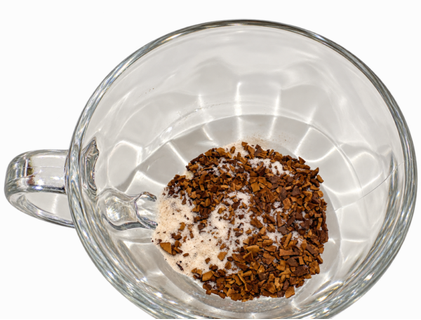
The product contains xanthan gum, sodium citrate, and dextrin, which are also among the ingredients discussed in Morinaga Milk Industry’s related patents.
I could not confirm whether the patented technologies themselves are used in this product.
However, the ingredient composition and my preparation experience made me wonder whether dispersibility and consistency were among the formulation considerations.
This is my interpretation rather than a confirmed explanation of the manufacturer’s formulation design.
●A Noticeably Thick Consistency
Before trying the coffee, I expected a relatively thin consistency.
Because it is served in coffee shops, I had imagined that it might be intended primarily for people with comparatively mild swallowing difficulties.
Once prepared, however, it was noticeably thicker than I had expected.
The thickness was visually apparent, and it reminded me of kuzuyu, a traditional Japanese drink thickened with kudzu starch.

Based on visual observation and my personal tasting experience, I felt that the consistency resembled the “moderately thick” category in the Japanese Society of Dysphagia Rehabilitation’s classification system.
This was only a subjective impression, not a classification based on standardized viscosity or flow measurements. It should not be used to determine whether the drink meets a prescribed thickness level.
According to information about its development, the product was intended to be enjoyed by a wider range of people.
I wondered whether this development aim might be related to the relatively substantial thickness I observed, although I cannot confirm that connection.
However, the appropriate level of thickness varies according to each person’s swallowing function.
This product is not necessarily suitable for everyone with swallowing difficulties.
For someone with dysphagia, the appropriate drink consistency should be determined with the relevant healthcare professional, rather than relying on my tasting impression or the product description alone.
●Does It Still Taste Like Coffee?
Thickening a drink can change its taste and mouthfeel, and some people find thickened beverages less enjoyable.
In nursing care settings, I have encountered many people who are reluctant to drink thickened beverages.
I have also tasted thickened water, tea, and juice myself.
I found sweet juices relatively easy to drink.
However, thickened water and tea had an unusual mouthfeel and taste that I personally found less pleasant.
Research has also reported that adding thickening agents can change taste perception.
One possible explanation is that thickened liquids may remain on the tongue longer, potentially affecting how flavors are perceived.
What about Komeda’s Thickened Coffee?
When I tasted the prepared coffee, I personally noticed little of the unusual taste or aroma that I sometimes associate with thickened beverages.
It had a recognizable coffee aroma and bitterness, with a lingering coffee flavor after swallowing.
Flavor is an important part of the coffee Komeda serves in its cafés.
According to Komeda’s product information, the developers aimed to recreate the characteristic flavor of Komeda Blend in a thickened coffee. This describes the stated development aim, not the result of an independent sensory comparison.
I do not drink Komeda’s regular coffee frequently, so I cannot judge how closely the product matches the original Komeda Blend.
After trying it, I felt that this product was about more than simply offering thickened coffee. It also seemed to place value on the experience of enjoying Komeda’s coffee.
Another interesting detail is that the home-use coffee is prepared with 150 mL of hot water.
According to the product information, this amount was chosen with the serving size of Komeda’s regular blended coffee in mind.
Apart from flavor, I have also noticed that some thickened drinks seem to stay warm for longer, although cooling depends on factors such as the container and preparation conditions.
From my nursing experience, I have the impression that many older adults enjoy their tea or coffee hot.
For people who prefer hot drinks, warmth may be another aspect of the drinking experience to consider. I did not measure how quickly this product cooled.
Where to Find Komeda’s Thickened Coffee
Komeda’s Thickened Coffee is available at selected Komeda Coffee locations in Japan.
It is not served at every store, so it is advisable to check the participating locations before visiting.
As of October 2026, the in-store price has been reported as ¥520 per cup.
An individually packaged version is also available for home preparation.
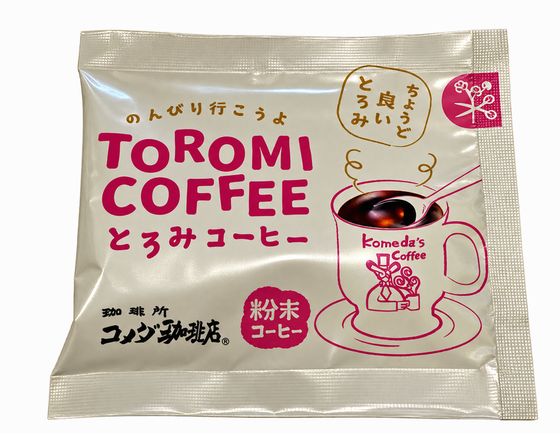
Each sachet contains a single serving of coffee and thickening ingredients, making it convenient to prepare at home.
A package containing 15 servings is available through Komeda’s official online store.
The product is also available through online retailers such as Amazon.
At a price of ¥1,900 for 15 servings, the cost works out to approximately ¥127 per cup.
Please note that availability and prices may vary depending on the retailer and the time of purchase. Check the relevant product listings for current information.
Closing Thoughts
For many older adults in Japan, visiting a coffee shop or enjoying a Japanese-style café breakfast, often called “morning service,” is about much more than food and drinks.
Meeting friends, going out with family, or reading the newspaper alone over a cup of coffee may be part of a routine they have enjoyed for many years.
However, when swallowing function declines, people may need to modify their drinks or face other restrictions when eating and drinking outside the home.
As a result, activities they once enjoyed may gradually become less accessible.
That is why I believe it is important to have alternative ways to continue enjoying familiar experiences, even when enjoying them in the usual way becomes difficult.
At participating Komeda Coffee locations, the availability of a thickened coffee option may allow some people to share a café visit with family or friends, depending on their individual swallowing needs.
For those who find it difficult to go out, the home-use version may offer another way to enjoy coffee at home, if its consistency is appropriate for them.
For family caregivers, combining the coffee and thickening ingredients in one sachet may simplify the preparation steps.
Through my research into the ingredients and related patents held by Morinaga Milk Industry, I came to appreciate that the design of a thickening agent involves much more than simply increasing viscosity.
Even a single cup of thickened coffee brings together molecular-level chemistry, the physical properties of liquids, and the mechanics of swallowing.
I believe these formulation approaches are worth examining not only in terms of the physical properties relevant to swallowing, but also for their potential to offer more choices for enjoying familiar drinks in everyday life.
Looking at thickened coffee this way has changed my impression of the product and deepened my interest in what these technologies may make possible.
Disclaimer:This article is provided for informational purposes only and does not guarantee the accuracy of the information presented. Please review the relevant information and make your own decisions regarding product purchase and use.
This blog explores assistive products, medical supplies, and care products from the perspective of medical and long-term care settings in Japan.
I focus particularly on how products are perceived in frontline care settings and the situations in which they are likely to provide value.
Drawing on my hands-on nursing experience and knowledge of patents, I also provide technical writing, explanations of medical materials and care products, product reviews, and support related to market development.
Through this work, I aim to serve as a bridge between companies and frontline care settings.
For more information, please visit Services.
If you would like to discuss a project or potential collaboration, please contact me through the Contact form.
References
Sakai, T. Anatomy and Physiology. Igaku-Shoin, 2010.
Morinaga Milk Industry / Clinico. Product information on thickened coffee.
https://www.clinico.co.jp/news/toromi-001.html
Komeda Coffee Official Online Store. Thickened Coffee product page.
https://ec.komeda.co.jp/products/%E3%81%A8%E3%82%8D%E3%81%BF%E3%82%B3%E3%83%BC%E3%83%92%E3%83%BC
Morinaga Milk Industry Co., Ltd. “Thickening Composition” (descriptive English translation of the Japanese patent title). Japanese Patent No. 7429801.
Morinaga Milk Industry Co., Ltd. “Thickening Composition” (descriptive English translation of the Japanese patent title). Japanese Patent No. 7685539.
“Changes in Basic Taste Thresholds and Taste Intensity Following the Addition of Food Thickeners” (descriptive English translation of the Japanese article title).
https://www.jstage.jst.go.jp/article/jsdr/18/2/18_131/\\_pdf/-char/ja