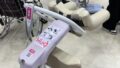
In my previous articles, I looked at transfer assistance from an ergonomics perspective—especially the biomechanics of the sit-to-stand movement—and I also introduced a transfer robot designed to support standing up.
→ Ergonomic Perspectives on Transfer Assistance and Low Back Pain
→ How the Hug Stand-Assist Robot Supports Standing Up
This time, I will focus on a different approach: instead of guiding a sit-to-stand motion, this is a transfer-support robot that enables transfers while the user remains seated—Akane Welfare Co., Ltd. (Akane Fukushi)’s “Ijo Desu II.”
In this article, I will explain “Ijo Desu II” in detail, focusing on its key features from an ergonomics perspective, what can be inferred from patent documentation, and how I think it can be used in real care settings.
Please note that this article reflects the author’s personal views and my own research.
It does not guarantee accuracy.
Any decision to purchase or use the product should be made at your own discretion and responsibility.
What is Ijo Desu II?
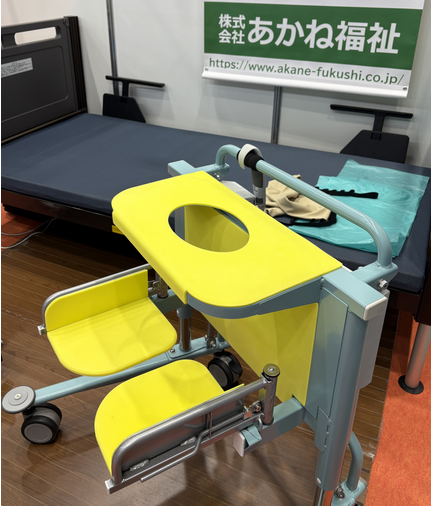
Ijo Desu II is a transfer-support robot developed and sold by Akane Welfare Co., Ltd. (hereafter “Akane Welfare”).
The manufacturer’s concept is to “achieve safe and secure transfers without discomfort for either person.”
In line with that concept, Ijo Desu II is designed not to guide the user into standing, but to support transfers while the user remains in a seated posture.
How Ijo Desu Works
The Sit-to-Stand Movement
Standing up is one of the daily movements that can easily become unstable.
In transfer assistance, caregivers often need to support the user during this sit-to-stand phase in some way. That makes it a high-risk moment for falls and a situation that can place a burden on both the user and the caregiver.
(I explained the sit-to-stand movement in detail in earlier articles.)
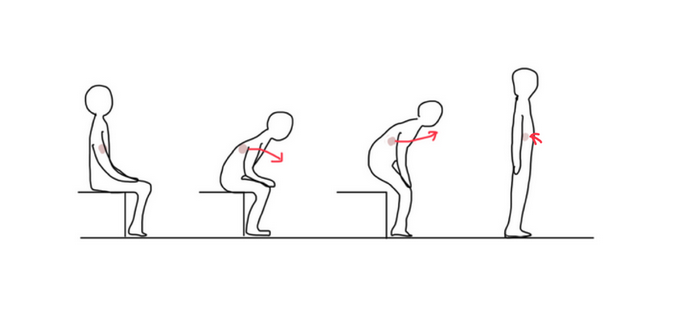
Here, to understand how Ijo Desu II works, I will briefly summarize two key points of the sit-to-stand movement: changes in posture, and changes in the center of gravity (CoG) and the base of support.
When a person stands up, the body typically moves in this sequence:
Lean the trunk forward
↓
The buttocks lift off the seat surface
↓
Extend the knees and push the body upward
At the same time, the CoG also shifts substantially:
In sitting: toward the rear
↓
Leaning forward moves it forward
↓
Knee extension moves it upward
In other words, the CoG moves in a broad arc.
In addition, at the moment the buttocks leave the seat, the base of support becomes narrower—shifting from “seat + feet” to “feet only.” As a result, the body becomes unstable.
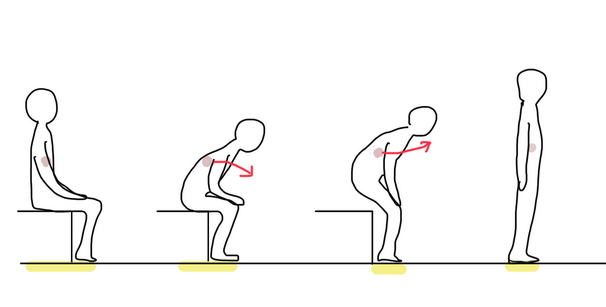
So in a typical sit-to-stand, the movement is prone to becoming unsteady because of these two factors:
- The CoG shifts significantly
- The base of support becomes narrower
The Ijo Desu II Approach
With Ijo Desu II, transfer assistance is performed without carrying out the unstable sit-to-stand movement itself.
In my view, the most important feature of Ijo Desu II is that it avoids placing the user in an unstable posture.
So how does it enable transfers while the user stays seated? Below, I will explain the flow, step by step, while describing its structure and mechanism.
In this article, I also refer to patent documentation that appears relevant to Ijo Desu II. However, patents do not necessarily match the current commercial product. For that reason, I present the patent content here as reference information.
In the patent, the problems described for conventional transfer devices that use a lever mechanism include points such as: “lifting is required,” “the caregiver must apply force during operation,” and “stability is insufficient.”
To address these issues, the document describes a structure aimed at a motor-driven system that reduces caregiver burden and enables safer transfers.
Structure
- Grip / Front Table: A place where the user can rest their arms to stabilize the upper body.
The table has an opening, allowing the caregiver to pass a hand through it. This design makes it easier to assist by lifting the user’s thighs from above and placing them onto the lifting plates.
- Knee Support Plate: A surface where the user’s knees lightly contact.
- Lifting Plates (Thigh Support Section): Plates that slide in from both sides under the thighs and lift the body.
The plates open and close from the left and right and can be locked in place.
- Caster-Mounted Base (Cart): The caregiver can push the device to move it.
Product information states that it can pass through spaces with roughly a 1-meter width, which makes it easier to use near bedsides and in toilets.
- Safety Belt: Wrapped around the back at approximately chest-to-waist height to stabilize the body.
- Lift Mechanism (Actuator): A motor-driven mechanism that raises and lowers the lifting plates with button operation.
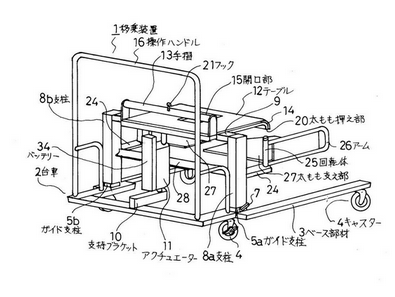
Source: Utility Model Application Jitsugan 2015-5931 (Akane Welfare Co., Ltd.)
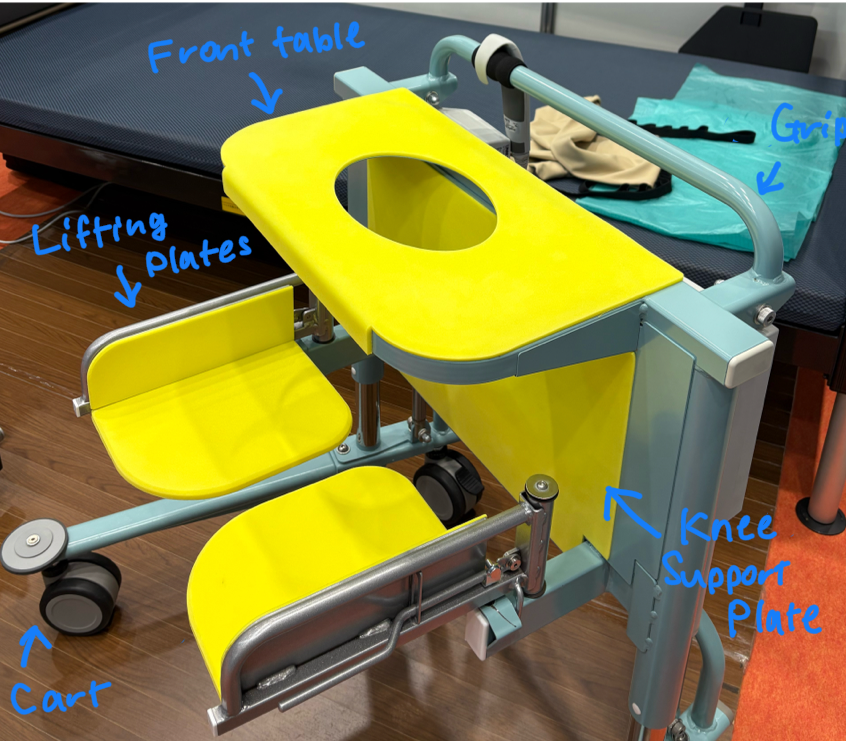
How It Works
① Stabilize the user’s posture
First, while the user remains seated on a chair or bed, Ijo Desu II is positioned from the front.
At this time, the user gently brings their knees together and aligns their knees so that they lightly contact the knee support plate.
The user then holds the front grip or places their arms on the table and takes a slightly forward-leaning posture.
In this posture, the body is supported at two points in front—the arms and the knees. In addition, by fastening the safety belt at a position that supports the pelvis/waist area, backward tipping is prevented and overall stability increases.
② Slide the lifting plates under the thighs
Next, the lifting plates are slid under the left and right thighs.
The user shifts their upper body slightly to the left and right.
During that movement, the caregiver inserts a hand through the opening in the center of the table, gently lifts the thigh, and slides the plate in from the outside as if “gliding” it underneath.
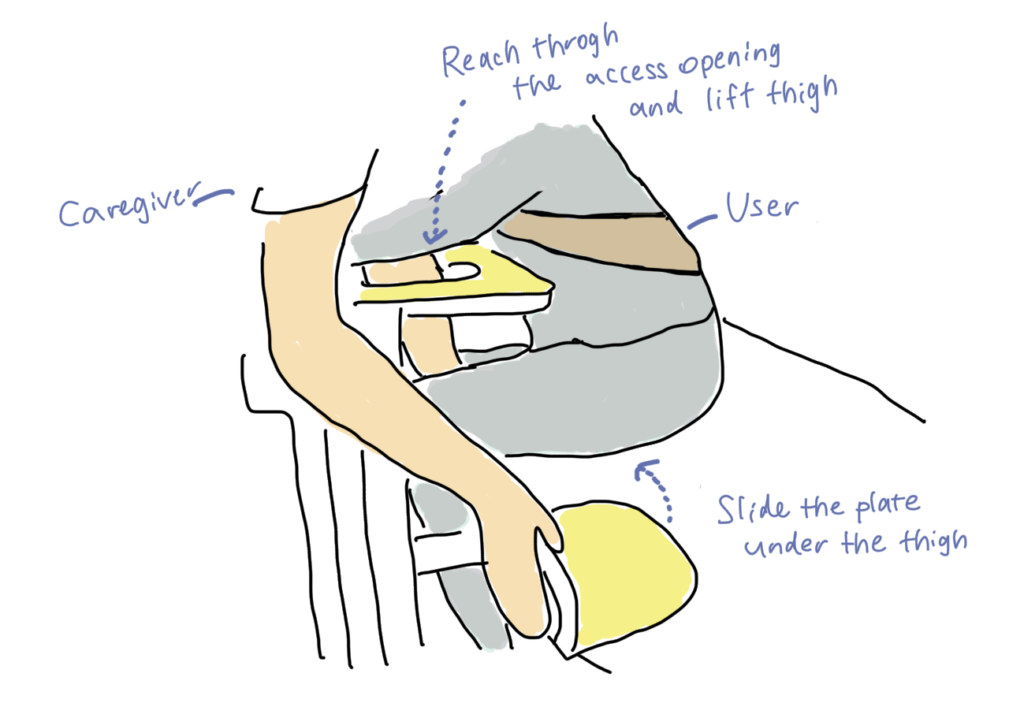
Because the lifting plates are split into left and right sections and can be inserted separately from the outside, it is not necessary to lift the buttocks significantly.
Regarding this lifting-plate design, the patent describes specific measures intended to improve safety and usability, such as:
- A structure that allows the caregiver to insert a hand through the table opening to lift the thigh, while operating the lifting plate with the other hand—reducing operational burden and helping prevent pinching of skin, etc.
- A plate shape that is not a simple rectangle; by chamfering the front corner section diagonally, the design helps avoid pinching the groin area when used without clothing.
(In the current product, this area appears to have a curved shape, which may provide an even safer form.)
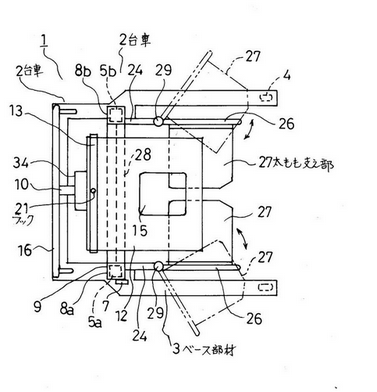
Source: Utility Model Application Jitsugan 2015-5931 (Akane Welfare Co., Ltd.)
- The plates can be locked in the closed position to prevent them from opening during transfer and to ensure safety.
③ Raise → Move → Lower
Once everything is set, the caregiver presses the “Up” button on the remote. The user’s body—supported on the lifting plates—then rises automatically in the vertical direction.
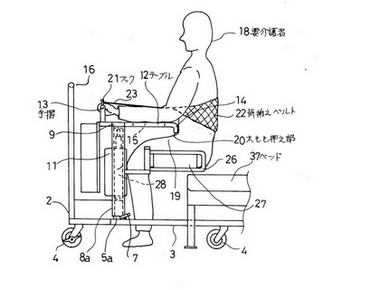
Source: Utility Model Application Jitsugan 2015-5931 (Akane Welfare Co., Ltd.)
Because this lifting motion is motor-driven, the caregiver does not need to apply physical lifting force. The patent also indicates that reducing the caregiver’s physical burden is a major objective.
When the user has been raised to a height where their feet are off the floor, the caregiver stops the lift, rolls the caster-mounted base, and moves the user to the destination.
After arriving, the caregiver performs the lowering operation and places the user down onto the new seat surface.
Finally, the safety belt is removed and the user’s posture is adjusted. The transfer is then complete.
Postural Changes and Stability During Transfer
In this transfer motion, the user’s primary movement is mainly vertical movement while remaining seated.
Even if we look at finer movements, they are limited to:
- A slight forward-leaning posture
- A small lateral weight shift when inserting the plates
Because posture changes are minimal, the transfer can be described as having small CoG displacement.
Looking at the base of support, even if there is a moment when the feet leave the floor, the user is not required to spend time supported by “feet only,” as in standing. A posture close to sitting is maintained during the transfer.
For these two reasons, I consider the design to be relatively stable during transfer.
That said, Ijo Desu II does not provide a firm backrest or seat surface, and it does not use a sling that wraps the body, as conventional patient lifts do.
As a result, the upper body is subject to forces that would tip it forward/backward/sideways—in other words, a rotational tendency (torque or rotational moment).
(I explain rotational moments in Transfer Assistance and Low Back Pain: An Ergonomics Perspective.)
With Ijo Desu II, it appears that the support points are arranged to counteract these tipping forces with minimal support.
At the front, the arms receive the “forward-falling force,” and the knee support plate receives the “movement of the pelvis sliding forward.”
At the rear and sides, the safety belt restrains “backward and lateral tipping forces.”
And from below, the thigh plates support the body.
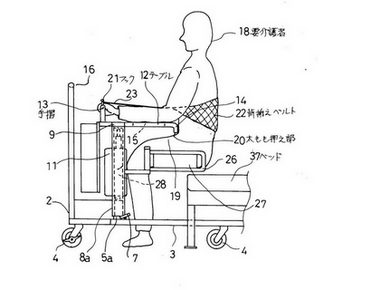
Source: Utility Model Application Jitsugan 2015-5931 (Akane Welfare Co., Ltd.)
Even though the body is wrapped in a sling, the user appears stable because the forces are received at effective locations in a well-balanced way.
One aspect I find particularly distinctive is that the device supports and lifts the body not at the buttocks—where body weight is typically concentrated in sitting—but at the thighs.
The design intent is not explicitly stated. However, personally, I feel thigh support may offer advantages such as the following:
- Less discomfort: The thighs are easier to support over a broad surface area and have fewer bony prominences.
Many older adults have low body mass, and sitting can cause pain at the bony parts of the buttocks. Supporting the thighs may reduce discomfort or pain. - Easier insertion: Because the plates are split left/right and can be inserted from the outside, posture change may be easier to minimize compared with inserting support under the buttocks.
As a result, the user may remain more stable, and the caregiver may experience less physical strain because heavy lifting is not required. - Easier toileting care: Product information also notes that the open buttock area makes it easier to manage clothing up/down and perform perineal care.
This is, in my view, a major practical advantage that conventional sling lifts do not provide.
Note: I cite diagrams from the related utility model (Jitsugan 2015-5931) as reference material, but they may not match the specifications of the current commercial product.
When Ijo Desu II Is Suitable and When Caution Is Needed
According to the manufacturer, Ijo Desu II is designed for users who can maintain sitting with support.
Based on that premise, and on the structure and mechanism discussed above, I will organize cases where Ijo Desu II may be suitable and cases that require caution.
The points below include my personal analysis. In actual practice, please confirm details with professionals and/or the manufacturer and make decisions accordingly.
Cases Where It May Be Helpful
- People whose sit-to-stand is unstable
Because it does not involve the process of rising into standing, it can help avoid fall risk during standing up.
- People who have difficulty bearing weight and extending the lower limbs
The user does not need to plant the soles firmly, push through the legs, and extend the knees to achieve standing.
For that reason, it may enable transfers in cases involving contractures, deformities, or inability to generate sufficient force in the lower limbs.
Depending on severity, it might also be applicable in cases such as paralysis.
- Situations where transfers are mainly “seated-to-seated”
It may be suitable for transfers between a wheelchair, a toilet seat, a shower chair, and other seated surfaces—when you want to keep the user stable during the move.
- Transfers that include toileting assistance
In toileting, if standing is unstable, two caregivers may be needed—one supporting the user from the front while the other lowers clothing from behind.
Unlike a conventional sling sheet that wraps the body, Ijo Desu II leaves the lower body open, which may make it easier for one caregiver to manage clothing up/down and perform perineal care.
I also feel the ability to use it in relatively small spaces is a major advantage in toilet environments.
- When you want to reduce caregiver burden
According to the manufacturer, transfers take approximately 2–3 minutes, and the device can be operated by a single caregiver standing in front of the user.
Because it does not require manual lifting, it may reduce low-back strain risk. The device’s slogan also appears to be: “Enjoy transfers while chatting!”
Cases That Require Caution
- When sitting is difficult even with support
Because the method is fundamentally based on sitting, it is difficult to use for people who cannot maintain a seated posture.
- When it is difficult to insert the plates under the thighs
In cases with severe contracture or pain that makes insertion under the thighs difficult, use should be considered carefully.
- When the user strongly resists due to cognitive impairment
If verbal prompting and understanding of the process are difficult, and the user strongly refuses the device, additional safety considerations are required.
Practical Use in Care Settings
I personally tried Ijo Desu II at an exhibition, and I felt that the user’s posture changed very little during the transfer, making it less likely to feel unstable.
During the demonstration, I wondered, “Can it really lift someone by the thighs?” But the body was lifted securely. I felt very little discomfort such as the back of the thighs being “dug into,” and I did not feel sudden shifts in load.
I felt that the ease of inserting the plates, the minimal postural change during transfer, and the toileting-friendly structure are closely related and together improve usability in real care settings.
When these factors work together, they may lead to transfers that are less physically demanding for both the user and the caregiver.
When I tried to imagine how it could be used in real practice, the first image that came to mind was my mother at home several years ago.
At the time, she spent longer hours in bed. Her ankles developed an inward contracture, and she could not place the soles of her feet firmly on the ground, making it difficult to bear weight.
Even so, she frequently wanted to go to the toilet. During that period, each transfer required assistance that was almost like lifting her up and holding her.
If we had been able to use a device like Ijo Desu II at that time, I believe transfers could have been less painful—not only for our family, but also for her.
Closing Thoughts
When I tried Ijo Desu II at the exhibition, I received a book introducing Akane Welfare’s initiatives.
It described how Akane Welfare is not only manufacturing and selling welfare equipment, but also working directly with challenges faced by care facilities and using welfare equipment to help solve real on-site problems.
When I learned about that approach, I strongly felt, “This is exactly what we need right now,” and I deeply agreed.
As staff shortages continue in the long-term care industry, welfare equipment should not be introduced as an end in itself. What matters is how it is actually used on site and how it changes workflow and quality of care.
That mindset also seems reflected in Ijo Desu II’s slogan: “Enjoy transfers while chatting.”
Manual transfers often become painful care—for both the person being transferred and the person doing the transfer.
A caregiver’s feeling of “I don’t want to do this” can be communicated to the user. In fact, I have heard users say, “I’m sorry for causing trouble.”
If there are systems like Ijo Desu II that enable transfers with less burden, transfers could shift from being a “painful task” to becoming “a time for interaction where conversation happens.”
In my own work, I have also felt again that through activities such as promoting the use of welfare equipment, I hope to increase moments where care is not only “hard,” but also includes moments that feel “enjoyable.”
I currently share insights from both nursing practice and patent research, and I also write technical articles on care products and medical materials.
If you are interested in collaboration or would like support with product explanations or market research, please feel free to contact me through the form on my blog.
This article is for informational purposes only.
It does not guarantee accuracy, and decisions about product use or purchase should be made at your own judgment and responsibility.