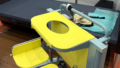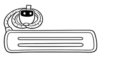
In medical settings, many people tend to think of nail polish as something that should be avoided.
That is not only because staff wearing nail polish may create a negative impression, but also because a patient’s nail polish can sometimes interfere with medical care.
However, things can be a little different in elderly care settings.
In Japan, “welfare nail care” has been gaining attention as a way to bring beauty and enjoyment to older adults and people living with illness or disability.
There is even a term, kaigo beauty (“beauty care in eldercare”), which reflects a growing effort to integrate beauty into care.
In this article, I will focus on Aqure Nail Pen, a nail product developed for welfare and care settings that I came across at an exhibition last year.
A product described as “designed for care settings” may sound appealing at first glance.
But when you actually want to introduce something into a care environment, it is much easier to move forward when you can clearly explain what is beneficial, and why.
That is why this article takes a closer look at Aqure Nail Pen, including the chemistry behind nail products and how those mechanisms may relate to practical advantages in care settings.
Disclaimer
This article reflects the author’s personal views and research. It does not guarantee accuracy or completeness. Any decision to purchase or use the product introduced here should be made at your own discretion and responsibility. This article may contain affiliate links (PR).
Nail Products in Elderly Care Settings
Anyone who has ever worn nail polish probably knows the feeling that neat, polished nails can lift your mood.
One reason nail services are introduced in elderly care settings is precisely that kind of emotional change.
Below are some of the potential benefits of nail care in these settings, along with the points that require caution.
Benefits
It can brighten a person’s mood.
Beautifully cared-for fingertips may help some people feel more positive and even soften their facial expressions.
It can create conversation.
It may become a natural topic of conversation with staff and can also encourage interaction among residents or users.
It can encourage hand activity.
Choosing colors and going through the application process can provide an opportunity to use the fingers and hands.
Points That Require Caution
Odor
Some people are sensitive to the characteristic smell of nail products.
In spaces where ventilation is limited, that odor may become a burden.
Waiting for the product to dry
In time-limited settings, not being able to wait until the nails are dry may become one reason the activity does not go smoothly.
The effort required for removal
Typical nail polish often requires nail polish remover, which adds preparation and cleanup, and may also cause discomfort because of odor or irritation.
Difficulty of application
Application itself may be difficult if the person applying it is not used to nail products, or if the person receiving care has limited hand movement or cognitive decline.
Impact on observation and monitoring
Polished nails can make nail color harder to assess and may affect SpO₂ measurement.
Infection-related concerns
If someone has a nail condition such as onychomycosis, extra hygiene considerations may be necessary when products are shared.
The Chemistry of Typical Nail Polish
“Chemistry of nail polish” may sound complicated, but the basic idea is simple: typical nail polish is a liquid containing film-forming materials that is applied to the nail and then dries into a thin film.
The main component that remains on the nail is the resin or polymer.
In many conventional nail polishes, a common film-forming material is nitrocellulose.
However, the feel and behavior of a nail product are not determined by the resin alone.
Odor, drying time, ease of removal, and ease of application are strongly influenced by the other ingredients blended into the formulation, such as solvents, plasticizers, pigments, and viscosity-adjusting agents.
For example, the sharp smell associated with conventional nail polish mainly comes from volatile solvents escaping into the air.
Likewise, the reason remover is generally needed for removal is that the dried film must be dissolved again in order to take it off.
In other words, Aqure’s features—such as low odor, peel-off removal, fast drying, and ease of application—can also be understood not simply as impressions, but as differences in ingredients and film formation.
Aqure Nail Pen
Aqure Nail Pen is a water-based manicure whose main ingredient is water.
It is presented as a peel-off product with an easy-to-hold pen shape, no characteristic organic-solvent odor, quick drying, and compatibility with SpO₂ measurement.
Please note that this affiliate link opens a Japanese-language shopping page.
The publicly listed ingredients include water, acrylates copolymer, butylene glycol (BG), benzyl alcohol, and phenoxyethanol, among others.
At first glance, it may simply sound like a “gentle” nail product.
However, what really matters in care settings is whether it can actually reduce the burdens that often come with using nail products in practice.
That is the point I would like to explore here, from both a practical care perspective and a chemistry perspective.
Lavina Co., Ltd., the company behind the product, does more than sell the nail pen itself.
The company also provides beauty recreation programs for welfare facilities and offers seminars related to beauty in care.
Their message appears to value the idea that enjoying beauty should feel natural, regardless of age or whether someone lives in a facility.
Why Aqure Fits Elderly Care Settings
Low Odor
Low odor is a major advantage in care settings.
Some users are sensitive to smells, and nail-related activities may take place in rooms where ventilation is not ideal.
The sharp smell of conventional nail polish mainly comes from volatile solvents escaping into the air.
Aqure, in contrast, is presented as a water-based product without the characteristic odor associated with organic solvents.
That difference alone suggests that Aqure may be easier to handle in care settings than conventional nail polish.
Looking at the chemistry a little more closely…
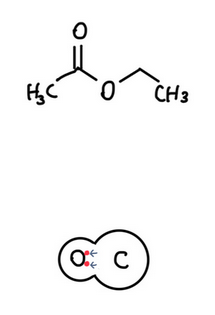
In conventional nail polish, ester solvents such as ethyl acetate are commonly used to turn the film-forming resin into a spreadable liquid.
These solvents mix well with the resin, but after application they also evaporate readily into the air.
That is what allows the film to remain on the nail—but it is also what creates the familiar sharp odor.
Looking at the molecular structure…
Esters contain a C=O group.
In that part of the molecule, the oxygen atom pulls electrons more strongly, so the oxygen side becomes relatively electron-rich, while the carbon side becomes relatively electron-poor.
Meanwhile, nitrocellulose, a typical resin used in conventional nail polish, also contains regions with electrical polarity, such as nitrate ester groups.
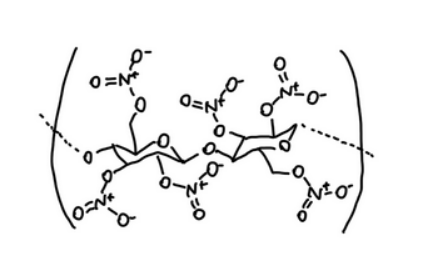
Because of this, ester solvents and nitrocellulose can interact at the molecular level through these polarized regions, making them compatible enough to form a spreadable liquid.
However, this attraction is weaker than the hydrogen bonding seen in water.
Because ester molecules do not contain an –OH group, they do not build the same strong hydrogen-bonding network that water does.
As a result, the molecules separate from each other more easily and escape into the air more readily.
In short, they mix well with the resin, but they also evaporate easily.
That property is closely tied to both the drying behavior of conventional nail polish and its strong odor.
Easy to Apply
“Easy to apply” means more than simple convenience in care settings.
The person applying the product may not be a beauty professional.
It may be a care worker, a family member, or in some cases even the person receiving care.
Aqure comes in a pen-type format, which feels closer to a familiar writing tool than to a bottle of nail polish.
That makes it easier to hold intuitively.
It is also less likely to be knocked over, spilled, or dropped and broken, which is a meaningful practical advantage in care settings.
The product is also introduced as having a thicker pen shape that is easier to hold even for people with weak grip strength.
When I actually tried it, the liquid looked somewhat thick inside the container, yet spread relatively smoothly once it was on the nail.
That combination—resisting drips, yet spreading easily during application—felt very practical.
Looking a little more closely at viscosity…
In a water-based nail product, polymers and particles may form a loose internal network in the liquid.
In that case, the liquid may resist flowing while it is sitting still, but become easier to spread when force is applied during brushing.
This kind of behavior resembles thixotropy: the product resists dripping at rest, yet flows more easily during application.
Looking at the polymer structure…
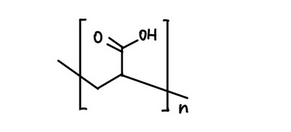
A polymer such as polyacrylic acid contains many –COOH groups along its chain.
Under certain conditions, these groups can become –COO⁻, increasing the negative charge along the polymer.
As the negative charge increases, the polymer chains repel each other and expand.
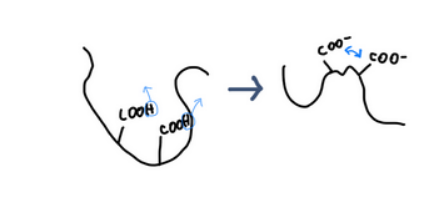
Those expanded chains occupy more space and hold more water, which makes it easier for the system to develop viscosity.
In addition, the formulation also contains stearalkonium hectorite, a plate-like particulate material.
Because of its plate-like structure, the particles can loosely associate with one another and form a three-dimensional network—often described as a card-house structure.
At rest, this structure helps support the liquid and contributes to its thickness.
When force is applied during spreading, that structure can partially break down, allowing the product to flow more easily.
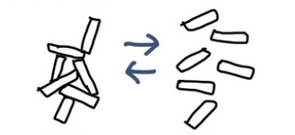
That helps explain why the product may look thick in the container but still spread smoothly on the nail.
Dries Quickly
Aqure is described as drying in about 30 to 60 seconds, which is a very meaningful point in care settings.
Activities in facilities often have limited time, and some users may have difficulty staying still or maintaining the same posture for long.
So fast drying is not only about saving time.
It also means the product may be easier to use in a way that fits each individual person.
Looking at the chemistry a little more closely…
In general, water does not evaporate as readily as ester solvents do.
Even so, Aqure is described as fast-drying.
One possible reason is that the film may be designed not to become overly thick, and the system may be optimized so that film formation proceeds efficiently in a water-based formulation.
So drying speed should not be reduced to a simple contrast of “water is slow” and “organic solvents are fast.”
It is more reasonable to think in terms of how thick a film is formed and how that film is formed.
If the product spreads easily and avoids becoming too thick, it may also feel faster to dry in practice.
Can Be Peeled Off
Aqure is described as removable without nail polish remover, which is a major practical advantage in care settings.
It reduces preparation and cleanup, and it also avoids the odor and irritation associated with removers.
This can also be helpful when there is a medical reason to remove nail color quickly, such as during an acute change in condition.
In addition, in care settings, the fact that removal requires less preparation and less cleanup—and does not involve the odor or irritation of remover—can be a meaningful advantage.
Conventional removers, especially those involving acetone, may also cause dryness or irritation to the nail and surrounding skin.
For that reason, even without saying that Aqure can “never damage the nail,” it still seems reasonable to view it as a product that may place less burden on the nail than conventional polish, because it is water-based and can be removed without using remover.
Looking a little more closely at how the film forms…
Conventional nail polish is a system in which the resin is dissolved in an organic solvent.
When it is applied, the resin in solution can more easily enter the fine irregularities of the nail surface.
After the solvent evaporates, the resin remains and solidifies as a film.
That is why remover is needed later: the film must be dissolved again in order to remove it.
Aqure, in contrast, appears closer to a system in which polymer is dispersed in water, rather than fully dissolved in an organic solvent.
Here, “dispersion” means that the polymer is not dissolved at the molecular level, but exists as very small particles distributed throughout the water.
When such a liquid is applied, those particles sit on the nail surface, and as water leaves the system, the particles move closer together and form a film.
So instead of a fully dissolved resin penetrating deeply into fine surface irregularities and solidifying there, the film may behave more like a sheet formed by polymer particles gathering together.
As an image, this may be a little like the difference between liquid glue, which seeps into small gaps before it hardens, and a sticker-like film, which sits more on the surface.
That may help explain why Aqure tends to peel away more easily from the edge.
Of course, easy peeling is not always an advantage in every situation.
For people with a risk of pica, accidental ingestion, or aspiration, that feature still requires caution.
Allows SpO₂ Measurement
Aqure is presented as compatible with SpO₂ measurement, which is an especially important point in medical and care settings.
SpO₂ is a value that indicates what percentage of hemoglobin in the blood is carrying oxygen.
It is an important indicator of oxygenation status.
Because it can be measured easily by placing a pulse oximeter on the fingertip, it is checked routinely in many care situations, much like body temperature or blood pressure.
A pulse oximeter estimates SpO₂ by shining light through the fingertip and analyzing changes in light absorption and transmission.
That is why nail products may affect measurement depending on film thickness, color, and the way the film transmits light.
Systematic reviews suggest that the effect of nail products varies depending on the color of the polish and the device used.
Some reports suggest that the clinical impact is small, while others report measurable errors under certain conditions.
Conventional nail products are often described as film-forming materials more similar to coatings, whereas Aqure has been explained as being based on water + pigment.
However, the effect on SpO₂ measurement is unlikely to be determined by the color material alone.
Film thickness, uniformity, and optical behavior are also likely to matter.
So rather than reducing the explanation to a single reason, it seems safer to say only that Aqure may form a film with properties different from those of conventional nail polish.
Even if SpO₂ can still be measured, polished nails can make nail color harder to observe, so that point still requires caution when the person’s medical condition calls for close observation.
Hygiene
From an infection-control standpoint, individual use is the safest approach.
That said, in facility-based recreation, individual use may not always be realistic.
Unlike a typical bottle-type nail polish, Aqure uses a structure in which the liquid is delivered toward the brush tip rather than requiring repeated dipping of the brush back into the main liquid reservoir.
Because of that difference, it may be easier to manage the product in a way that does not repeatedly return the brush to the entire contents.
After use, wiping the brush tip felt relatively manageable in practice.
Still, this should not be taken to mean that shared use is automatically safe.
If there are nail abnormalities or possible infections, use should be avoided, and facility rules and medical judgment should be prioritized.
Where to Buy
Aqure Nail Pen is available through its official channels and through online stores that handle care-related products.

【ネイルペンアキュレ】水性マニキュア ペン型マニキュア 水性ネイル シニアネイル キッズネイル ネイルペン はがせる 速乾 介護美容 福祉ネイル リハビリ 介護予防 認知症予防 高発色
Please note that this affiliate link opens a Japanese-language shopping page.
From what I confirmed, it can be purchased one pen at a time in selected colors.
The available lineup includes clear shades and glitter options, so it is possible to start by trying just one color.
Compared with an ordinary manicure, there is a price difference.
However, given the features designed for use in welfare and care settings, it does not seem like a product that can be compared on price alone.
Trying a single pen first to check the color and usability may be a practical place to start.
My Experience and Practical Notes
I also purchased and tried Aqure myself.
The following points are personal impressions and practical observations.
Odor
Before application and during drying, I noticed almost none of the sharp odor typically associated with nail polish.
Since I personally dislike that smell, this alone felt like a meaningful advantage for use in care settings.
Ease of Application
The liquid looked thick and slow-moving in the container.
When I intentionally dispensed a larger amount, it kept a rounded, raised shape rather than running.
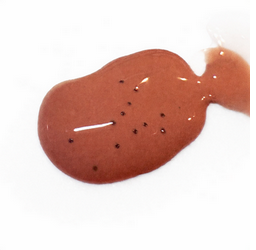
At the same time, once it was on the nail, it spread relatively smoothly.
Because it comes in a pen form, it can be held much like a pen, and the brush has enough firmness that even I—someone not particularly experienced with applying nail products—found it easy to handle.
Drying Time
It did feel quick to dry.
I think that would make it easier to use not only in time-limited recreation sessions, but also with people who have difficulty staying still or maintaining the same posture for long.
SpO₂ Measurement
Using an inexpensive pulse oximeter I had at home, I was still able to obtain an SpO₂ reading from a finger with the product applied.
However, that was only my own small-scale personal check.
Results may vary depending on the device, the color, and how the product is applied.
It is also important to remember that nail color becomes harder to assess once the nail is coated.
For people who require close medical observation or who have a higher risk of sudden change in condition, this point still deserves caution.
In more recreational settings, such as a day service environment for relatively stable users, it may not always need to be treated as an absolute problem.
Even so, leaving one finger uncoated may be a reasonable precaution.
If SpO₂ is an especially important monitoring parameter for a particular person, it may be safer not to use the product and instead follow facility rules and medical staff instructions.
Ease of Peeling Off
After drying, the product could be lifted and peeled off fairly easily from the edge of the nail.
Sometimes it came off in a more complete sheet, while in other cases it came off in smaller pieces, perhaps depending on how thinly or unevenly it had been applied.
There were also times when it seemed to come off on its own after bathing.
In the context of welfare nail care, this easy removability seems more like an advantage.
That said, for people with a risk of pica or accidental ingestion, peeling fragments could still become a concern, so the decision should be made according to the individual’s condition.
Hygiene
From an infection-control perspective, individual use is still the safest option.
However, in facility-based recreation, that may not always be realistic.
Because Aqure is not a typical bottle-type product that requires repeated dipping of the brush into the liquid, wiping the brush tip after use felt easier as part of practical handling.
Still, this should not be interpreted as proof that shared use is safe.
If there are nail abnormalities or possible infections, use should be avoided, and facility rules and professional judgment should take priority.
Closing Thoughts
As life expectancy increases, quality of life, dignity, and the ability to enjoy small pleasures become even more important.
In that sense, bringing beauty into care settings has real meaning.
Women in particular tend to live longer, which may make these opportunities even more relevant.
When I tried using nail color again myself, I felt a small lift in mood.
Even a small moment of thinking, “My nails look nice,” can support a more positive feeling.
Seeing users smile through recreational activities is also one of the rewarding parts of care work.
Aqure seems to reduce several of the practical burdens that often make nail products difficult to use in care settings, and even for me—someone not especially used to nail products—it felt approachable and easy to handle.
Of course, facility rules and each person’s condition still need to be respected.
Even so, it seems like a product worth considering as one possible option for recreation in elderly care settings.
On this blog, I mainly focus on how welfare equipment and medical products are actually received in care settings and in what kinds of situations they are most likely to provide value.
From the perspective of real healthcare and long-term care practice, I aim to share information that helps bridge the gap between companies, service providers, and the field.
Based on that perspective, I offer support in areas such as explaining medical materials and care products, writing technical articles, reviewing products, and assisting with market development by drawing on both my clinical nursing experience and my understanding of patents. →Services
For inquiries about explanatory articles, product reviews, promotional and communication support, or exhibition-related assistance, please feel free to contact me through the form on this blog.
Disclaimer: The content of this article is provided for reference purposes only and does not guarantee accuracy.
Any decision to purchase or use a product should be made at your own discretion and responsibility.
References
- Raveena Inc. (Lavina Co., Ltd.)
https://raveena.jp - The Society of Cosmetic Chemists of Japan (SCCJ)
https://www.sccj-ifscc.com/ - Japan Health and Welfare Nailist Association (JHWN) (Japanese: 日本保健福祉ネイリスト協会)
https://fukushinail.jp/ - McMurry, John. McMurry Organic Chemistry, 8th ed. (Japanese edition). Tokyo: Tokyo Kagaku Dojin, 2012.
- Urabe, Yoshinobu. Kagaku no Shin Kenkyu [New Study of Chemistry]. Tokyo: Sanseido, 2019.